To understand the aspartame campaign and the noise pollution the activist fear campaigns have fed on for more than two decades, we need to go to the Ramazzini Institute, their studies, motives and media manipulation. What is this organisation, who is using it and for what opportunities? How is it tied to IARC, the US government and to American tort law firms?
Bernardino Ramazzini (1633-1714) was an Italian physician who has been called the father of occupational medicine. In 1760 he wrote De Morbis Artificum Diatriba (Diseases of Workers) where he catalogued various occupational health hazards.
Today, Ramazzini’s name is more associated with a controversial group of scientists who are trying to change how occupational health hazards are detected and managed. The Collegium Ramazzini was founded in 1982 but it should not be confused with the Ramazzini Institute, founded in 1971 (also claiming to be founded in 1987), which identifies itself as an independent, non-profit cooperative. But the fellows and staff make the confusion themselves. The best we can conclude is that the work of the Ramazzini Institute is supported by the Collegium Ramazzini as a research academy that oversees the Institute’s active research (much like a management board … I think). The active Collegium fellows feature on the Institute’s organigramme.
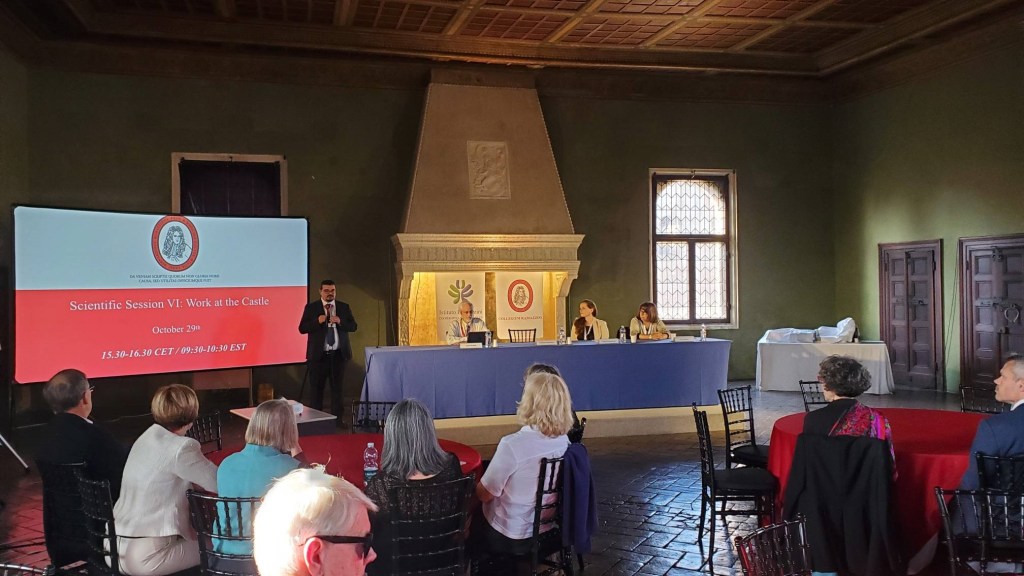
I once referred to the Collegium Ramazzini as a type of Rotary Club for activist scientists, mostly retired American regulatory scientists who use their peer-approved fellowships in this exclusive/seclusive network to arrange lucrative consultancy projects, places on IARC monograph panels and the subsequent US Predatort litigation consulting honey-pots. Many Ramazzini members have made millions using this network to become expert advisors in tort lawsuits for plaintiffs claiming damages, often based solely on IARC monographs.
I have generally ignored this organisation as just some shady network of IARC Good Old Boys meeting each autumn at an Italian castle for some fine wine while promoting greedy has-beens, poor peer reviews and unscientific activism. That was a mistake. More and more, I see the Collegium Ramazzini fellows as part of an activist cult, undermining scientific methodology in order to promote their political ideology. Their tactics are undemocratic and detrimental to the development of responsible research and innovation.
And nothing reflects their abuse of research integrity as much as the Ramazzini campaigns against aspartame.
A Cult of Charlatan Science
Institute Ramazzini claims to have more than 27,000 research associates (also claiming 35,000) with over 10,000m² of lab space at the Cesare Maltoni Cancer Research Center so it should be one of the world leaders in cancer research, but I never see webpages or pictures with more than 15 to 18 staff. They claim to be doing important ground-breaking science but the results are rather elusive if not non-existent. For example, they launched a major study on glyphosate in 2017 but all they have to show for, until now, is a pilot. They ran out of money.

Head of research at Ramazzini’s Cesare Moltoni Center, Daniele Mandrioli, had recently come to Brussels for several days to speak on the evils of glyphosate at the Pesticide Action Network’s Stop Glyphosate Week. He didn’t have much to say except to beg people for funding for his ongoing Global Glyphosate Study. In fact his white coat was so threadbare that he was relying on anti-glyphosate activist film-maker, Jennifer Baichwal, to produce a promotional video for his Institute Ramazzini. Like a faithful poodle, Daniele Mandrioli will be following Baichwal at every impact screening of her “Into the Weeds” lobbumentary to pose as the voice of independent science (while begging NGOs to tap their foundations and trusts for some cash). He has no choice, the cupboard is bare. Launching a Global Glyphosate Study crowdfunding site in 2017 after an initial €300,000 contribution from “30,000 Italian residents” (…!), the Ramazzini Institute has managed to raise €37,000 and 178 followers on Twitter.
How can Ramazzini pay the salaries and lab costs of 35,000 researchers (or even 15) or initiate expensive scientific studies when they don’t even have the budget for a two-minute PR video? Jennifer Baichwal’s film, Into the Weeds, was funded by US tort law firms, so it is a safe assumption that Daniele’s Ramazzini promotional video was Predatort-funded. With billions of dollars sloshing around in tort-law-firm slush funds following the 10.9 billion dollar glyphosate settlement, a few hundred million to Ramazzini would be a good long-term investment for generating future honey-pots (like, say, aspartame). One little caveat: the Ramazzini Institute would have to first prove they are a legitimate organisation.
Daniele Mandrioli is no doubt an expert on glyphosate. He also seems to be an expert on aspartame as he is flying the Ramazzini flag this week, participating on the IARC working group panel on aspartame. Willy Sutton has, once again, been proven right.
There is a memorable Monty Python sketch where Adolf Hilter is a candidate in the North Minehead By-Election (riding his bicycle around town screaming German slogans through a megaphone). Herr Hilter’s campaign and his 1970s plot for world domination is clearly ridiculous and its fraud evident to anyone who stopped to look. Whenever I see any claims from the Collegium or Institute Ramazzini, I am reminded of Adolf Hilter. There is indeed something very Pythonesque about this less than genuine organisation.
The Washington South Bypass
But the Predatort cash has not surfaced yet so Ramazzini still relies on their main sugar daddy: the US government.
Collegium Ramazzini has one essential utility: to serve as a tool for US regulatory scientists to run their special interests outside of, and around, Washington. The Collegium was founded in part by the controversial American activist scientist, Irving J. Selikoff, and has had the deep-pocket financial support from the National Institute of Environmental Health Sciences (NIEHS) since at least 2000. See a list of cooperation contracts signed and regularly renewed between the Institute Ramazzini and the NIEHS from 2000 to 2015. Hundreds of millions of US dollars have been distributed, non-transparently, by the NIEHS to support Ramazzini projects via third parties.
“USASpending.gov shows Ramazzini listed in 13 different NIH contracts, through four different third parties, for nearly two million dollars since 2009. Since Birnbaum’s tenure at NIEHS began in 2009, that agency has directed at least $92 million in grant funds to fellow members of the Collegium Ramazzini; NIH has given over $315 million in grant dollars for Ramazzini fellows since 1985.”
Source: E&E Legal
This is a substantial amount of US taxpayer money quietly sent to a small Italian non-government organisation rather than funding research projects in the US. Why would American research administrators do this? Outside of the obvious: that the then NIEHS head, Linda Birnbaum, is a Ramazzini fellow, I suspect NIEHS research projects would get too much political interference in Washington. So if American activist scientists could publish research from some “esteemed international organisation” or use the Ramazzini network to get IARC to produce a monograph, they could bypass the messy democratic process in the US and advance their agenda through alternative means (like the tort law process).
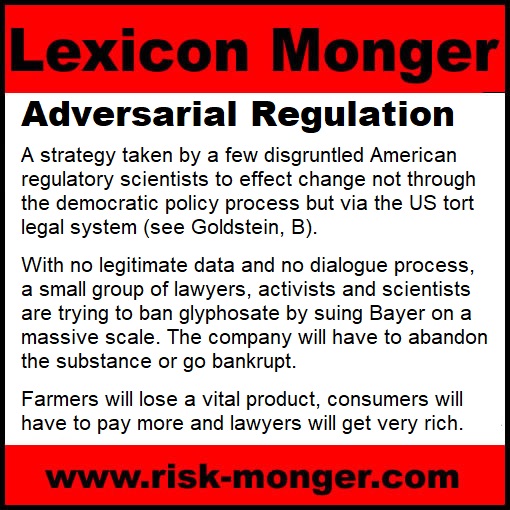
This is what happened with glyphosate. Washington was never going to bend to the activist scientists’ interests, so, using government funds, these political actors bypassed the democratic regulatory process and used the courts to try to get the herbicide of the century removed from the market (even though every regulatory scientific body has declared the substance is safe). Ramazzini fellow, Bernie Goldstein, even coined a term for this approach: “Adversarial Regulation“. Rather than conducting a risk assessment and advising regulators on policy options (within the political process), American scientists used the Ramazzini network to get IARC to publish a Predatort-ready cancer conclusion that the courts could then use to change corporate behaviour through relentless lawsuits.
And this is what is happening this week with aspartame. Scientists with interests in banning aspartame and attacking industry used the Ramazzini network to get IARC to hold a monograph panel to manufacture a carcinogenic label on the artificial sweetener (even though every regulatory scientific body has approved the substance as safe), upon which time the US tort lawyers will begin to sue the hell out of companies using aspartame until they either stop or go bankrupt. Goldstein once crowed that adversarial regulation is more effective than the precautionary principle (and it pads a lot of activist scientists’ pension funds).
Is it any surprise that the main founder of Collegium Ramazzini, Irving J. Selikoff, was best known for how he got into the mud with the asbestos industry. He must have known, first hand, that there needed to be a way to bypass Washington to reach his political objectives.
Many of Ramazzini’s members are retired US government scientists who use the Collegium as a type of “Washington South”. I suppose many of them follow their office’s own money to Italy to run their personal campaigns, write their papers and peer review each other (while enjoying a nice Chianti in a castle with a mountain view). The best example of this political collusion is how Ramazzini fellow, Chris Portier, used Ramazzini fellow, Linda Birnbaum and her office at the NIEHS, and Ramazzini fellow, Kurt Straif and his office at IARC, for support to run his campaign against glyphosate for the US tort law firms suing Monsanto.
Corruption? What corruption?
Ramazzini’s Obsession with Aspartame
The Ramazzini Institute was behind three controversial studies linking aspartame to cancer published in 2005, 2007 and 2010. Its findings were roundly rejected by the scientific community and by all regulatory agencies. In 2006, EFSA published its review of the first Ramazzini research, citing a litany of failures, inaccuracies in data interpretation and mismanagement while reaffirming the safety of the present aspartame consumption levels. A quality analysis of the methodologies of a series of aspartame papers judged the three Ramazzini studies all as “unreliable”. The Ramazzini Institute, its reputation tarnished, has since become associated with poor research practices. Aspartame was deemed safe; the Ramazzini Institute was deemed dangerous.
But the Ramazzini researchers announced their findings at public conferences, press releases and media interviews grabbing headlines with their alarmist claims linking aspartame to cancer. They became the darlings of the anti-industry, food puritan activist communities who happily ignored the wide scientific rejection and amplified their papers. Like glyphosate, the activist community has shown that they do not need scientific consensus or facts to be able to successfully run a campaign against industry and consumer products. Rather than accepting the views of the wider scientific community (and their own research incompetence) on aspartame, campaigners have changed the subject and positioned these scientists as heroically standing up to corporate lobbyists and regulatory science corruption. And Ramazzini researchers are comfortable playing into this role.
Crossing the boundaries between science and activism is even enshrined in the Collegium Ramazzini’s bylaws.
Taken as a whole, the purpose is to be that of a bridge between the world of scientific discovery and those social and political centers which must act on these discoveries to conserve life and prevent disease.
Leaders “must act” on the basis of a large number of factors in the decision process – that is where risk management differs from risk assessments. It is typical of this Ramazzini arrogance to think that the only thing that matters is what they could detect from their mouse studies from which they then dictate how regulators “must act”. Where does science end and the political activism begin? Am I the only one who feels uncomfortable with how political bias can influence the Ramazzini Institute’s research methodology? Or how their intolerance of dissent or the value of other societal factors is destroying public trust in science.
Since the 2010 study, Ramazzini researchers have been continuing their political campaign against aspartame. In a recent interview, Ramazzini Institute’s scientific director, Fiorella Belpoggi, confidently assured the journalist that aspartame would certainly be found to be carcinogenic in the upcoming IARC monograph. Given IARC’s track record, this is not a stretch, but was Belpoggi speaking as a scientist or as an activist campaigner? Throughout its history, Ramazzini has never distinguished between these two roles.
In 2021, Ramazzini fellow, and US Ramazzini board president, Philip Landrigan, with Ramazzini fellow, Kurt Straif, published a paper suggesting there was new evidence tying aspartame to cancers in mice, insisting from this that IARC must conduct a new aspartame monograph. (This week IARC is complying with their demand for that monograph.)
But this “Ramazzini elder” paper was more about an opportunity for political activism – to push reasons for the IARC monograph. Poorly written, the paper was meant to defend the earlier Ramazzini studies on aspartame and rewrite its shameful history. But the Landrigan-Straif paper was also poorly researched. For example, on the Harvard Nurses Health Study, they claimed the following:
A second epidemiological study conducted within the prospectively followed population of the Harvard Nurses Health Study carefully assessed exposures and reported a significantly elevated risk of non-Hodgkin lymphoma (NHL) in males who consumed one or more servings of soda per day.
But if you go to the Schernhammer et al paper they cited, you would find the following quote:
Conclusion: Although our findings preserve the possibility of a detrimental effect of a constituent of diet soda, such as aspartame, on select cancers, the inconsistent sex effects and occurrence of an apparent cancer risk in individuals who consume regular soda do not permit the ruling out of chance as an explanation.
The paper that Landrigan and Straif claim had “carefully assessed exposures” had served up a nothing burger (it was rejected by six other journals before finally getting accepted for publication). The cancer risks were at the same level among individuals who drank sugar-sweetened soda as those who drank aspartame-sweetened soda. I can only conclude that Landrigan and Straif did not even bother to read the Schernhammer et al paper they had cited (as expected given the quality levels found in Ramazzini charlatan science). But maybe Landrigan and Straif had read the press release around the publication of the paper. The findings were so dramatically communicated that Harvard had to apologise for the alarmism spread by the press release of a paper with such weak findings (and the lead author agreed).
But Landrigan and Straif were not embarrassed by their dreadful lack of research integrity. Their objective was to get IARC to move on conducting an IARC monograph on aspartame that the US tort lawyers could then use. They succeeded and their Ramazzini Good Old Boys network as well as the Predatort community were, no doubt, appreciative.
Still, I can understand how annoyed these Ramazzini elders must be when other scientists don’t listen to them or respect them. What they really need is a methodological tool that they could use to silence the dissent and allow them to more easily get what they want. Time to pull out the big Ramazzini guns.
Rigging the Process: The 10 Key Characteristics
Somewhere in Berkeley, California, Ramazzini fellow, Martyn T Smith, is looking out of his window dreaming of methods to find new ways of linking cancers with targeted consumer products … ones that will generate new publications, new litigation consulting contracts with his Predatort friends, new reasons to travel to Lyon and new confreres in Bologna. If only there were a more efficient way to create more convincing associations with cancers. His friends in Ramazzini and IARC would be willing to support him and apply his new, more efficient methodology to achieve their shared objectives.
Following two workshops in IARC, Smith developed a paper highlighting what he called the “10 Key Characteristics” of carcinogenicity, creating a sort of automated checklist to identify cancer hazards. Hazard-based assessments, remember, do not consider exposure levels, so if a substance can be associated in any way with a cancer, at any level of exposure, that is enough for IARC to attribute its deadly label. The 10 Key Characteristics makes that IARC attribution much easier (hell it can be automated, but that would put those two weeks of pleasant dinners in Lyon at risk).
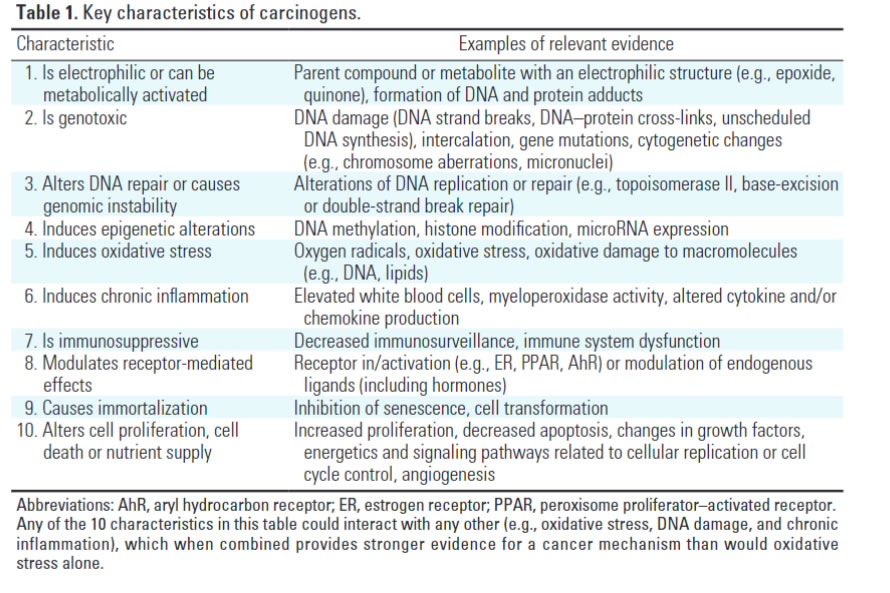
What Smith has done is assemble ten characteristics associated with carcinogenicity. See image from Smith’s paper. The logic is that the more of these characteristics a substance shares, the more carcinogenic it is. If benzene, for example, shares seven of the key characteristics, there is strong confidence that it is carcinogenic.
But some of these characteristics, like inflammation or genotoxicity, on their own, “do not a cancer make”. The authors of this characterisation will claim that it better defines the cancer association but perhaps we should ask the inverse: Is there any substance considered by using the 10 Key Characteristics that would not be associated with cancer? Probably not. So when these Ramazzini activists say that there is new evidence justifying another IARC monograph on, say, aspartame, what they are actually saying is that we have a new tool to make the “carcinogenic label” stick.
How is their behaviour scientific?
Predatortiary Pretence
At the same time, Ramazzini scientists have been demanding a new methodology to make IARC monographs more convincing. If benzene can tick seven of the 10 Key Characteristics, who would be able to argue against IARC’s conclusions? Certainly not American corporate defence attorneys.
Smith’s 10 Key Characteristics reflect an erroneous mindset that every cancer has a distinct cause. These same Ramazzini scientists are still livid about the argument that two thirds of cancers are attributed to bad luck. They have been trained to think of cancers as the result of some health justice equation – a consequence of lifestyle choices like tobacco and alcohol or negligence by a careless chemical industry. This prejudice of course is not scientific, but when you belong to an organisation like Ramazzini, with its cult rituals and secret handshakes, it is easy to forget about scientific methodology (or research integrity).
It is even easier to forget the scientific methodology when there are suitcases stuffed with cash waiting for you. If aspartame can get an IARC designation of “possibly carcinogenic”, then anyone with a cancer who has consumed a diet cola can join the Predatort free-for-all against some “yet-to-be-named” soda corporation (and those lawyers will be in need of a busload of Ramazzini-based litigation consultants).
How is this behaviour in any way scientific?
Checklist Science
The 10 Key Characteristics for carcinogenicity is like a checklist used for buying a house – if enough boxes are ticked, the deal is done (Is the garden big enough? Check!). But while these Ramazzini activists, on the surface, are using scientific concepts, the methodology is extremely weak (and borderline stupid). To say something causes inflammation and is therefore a carcinogen is not only vague, it will include many substances and activities that could not be realistically tied to cancers (like aubergines, peppers, tomatoes and jogging) but are indeed inflammatory. As an osteoarthritis sufferer, how often then will I now need to get my prostate checked? NB: Aspartame has been considered as inflammatory, but if I add it to my coffee, that should offset the effects (although, mind you, coffee is also carcinogenic even though, for most people who consume coffee in moderation, it is not inflammatory).
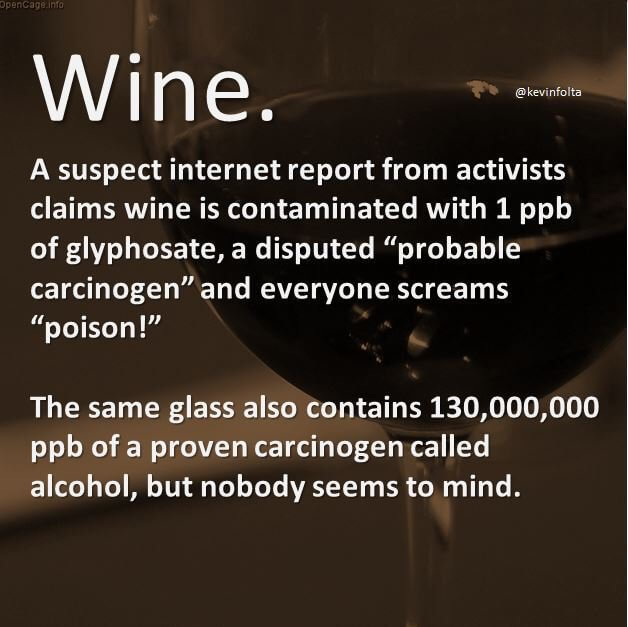
The Key Characteristic checklist approach ignores a basic law of toxicology: the Paracelsus Principle (the dose makes the poison). If glyphosate may be genotoxic, we need to consider at what level of exposure and for how long of a period. Ignoring Paracelsus is not just bad science, it reinforces scientific illiteracy among the general public.
Meaningless IARC hazard-based pronouncements have been capitalised on by activist opportunists and US tort lawyers to create fear and outrage against consumer products and the companies that provide them. When IARC pronounces aspartame as carcinogenic on June 14, 2023 (and they will), their press release will not qualify how many thousands of litres of diet soda you would need to drink each day to be at any serious risk of cancer. It ticked enough boxes, end of discussion.
These Ramazzini activists pulling IARC’s strings don’t care how the opportunists will exploit their findings. Rather, the IARC aspartame working group members will be spending the rest of June replying to emails from US tort law firms, signing lucrative litigation consultant contracts that will earn them millions of dollars over the next decade for simply telling juries three words: “IARC … WHO … cancer”. IARC knows how the Ramazzini fellows are exploiting IARC and this does not seem to concern them. IARC is Ramazzini and Ramazzini is IARC.
The 10 Key Characteristics simplifies a complex process. I am always nervous when I see such situations as they are usually connected to special interests … and so it is in this case.
The architects of the 10 Key Characteristics are part of the Ramazzini-IARC Good Old Boys network. Many have made millions as litigation consultants, testifying in US court cases based on their experience as IARC monograph panel members. As IARC’s monograph programme has lost the respect of the scientific community, there is a need to strengthen its conclusions.
Bad Science
What does the scientific community think of this Ramazzini effort to rig the IARC process?
A paper published by Becker et al found the 10 Key Characteristics to be so open as to not be able to competently discriminate between a carcinogen and a non-carcinogen. (I suppose Rick didn’t get the memo.)

In the image on the side, you can see 54 substances (in red) that were identified as carcinogens and 194 (in blue) were not. The Key Characteristics were unable to distinguish the non-carcinogens. The Becker et al study concludes that the Key Characteristics are no better at detecting causes of cancer than mere chance.
So anything that had been previously determined by regulatory risk assessments to be non-carcinogenic (like, say, aspartame), could now, under this new Ramazzini standard, be concluded to be a carcinogen. This fits the political ideology of the Collegium Ramazzini which is on a constant hunt for synthetic, industry-based substances they can label as carcinogens and then use in their political campaigns.
Becker et al made a curious observation. As there is no clear consensus among scientists and research organisations on how data is used to determine whether a substance is a potential cancer hazard, Martyn T Smith is using the perceived authority of IARC to impose his 10 Key Characteristics. The problem is that these Key Characteristics are ineffective as a hazard identification tool, leaving its use open to abuse. Are we capable of trusting that someone like Martyn T Smith would not then abuse this tool at IARC monograph working group meetings? (For the IARC aspartame monograph, the Don sent his faithful colleague).
Given the lack of research integrity exhibited by certain Ramazzini research fellows and their use of IARC to push their agenda, the ineffectiveness of the 10 Key Characteristics is seen more as an opportunity than a concern.
—-
Part 3 of AsparTort will look at IARC’s role in pursuing the aspartame monograph against the wishes of its members, their lack of professionalism and the interests of the scientists chosen to sit on the present aspartame monograph working group panel.
 The Risk-Monger
9 Comments Add yours