French translation
The profession of health journalism is at a low point … and probably going lower. With the flurry of stories following the well-telegraphed IARC leak on aspartame, a lot is being said by many news outlets, but little is factual.
Have you ever wondered why the main media outlets don’t use the Risk-Monger’s research, even as it is made freely available to them? He even offered prizes for the first mainstream journalist to pick up his exposé on 30 ethical transgressions at the heart of IARC. But the Risk-Monger does not say things health journalists would want to publish and does not spend his time in their faces demanding ink. These journalists only hear what they want to and only communicate with those feeding them scandals about the food industry. In other words, most journalists reporting on health and environment issues have become biased and lazy.
I recently had an interesting interaction with a health journalist from one of the largest American newspapers. I learnt more from her and how she practices her craft than she did from me. Here is a recount of my experience.
Thursday, June 29 started with the usual long, Monger exhale in front of the screen in his dusty basement. Reuters had published an article leaking news that the IARC Monograph 134 has concluded that aspartame is “possibly carcinogenic” (2B). That was not a surprise and a pretty safe editorial call. IARC has designed their hazard assessment model to automatically conclude any substance is carcinogenic (literally without fail). I was annoyed that the Reuters article relied on a lot of my research (the influence of Collegium Ramazzini, the American and Japanese letters to the WHO…), but chose not to cite my work.
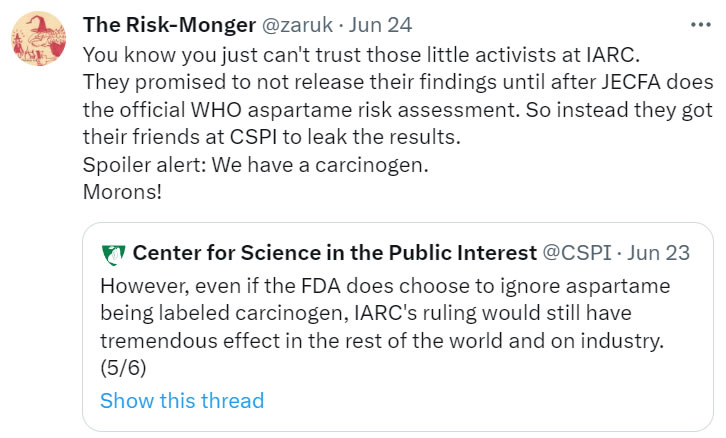
Then I got an email from a journalist from a major American newspaper asking me for an interview. To respect her privacy, I’ll just call her “Bambi”. I had criticised her article from the week before as a “nothing burger in service of anti-aspartame campaigners”. She was curious if I knew who had leaked the IARC results to Reuters. I shared the twitter thread from Peter Lurie, head of the anti-food industry NGO, Center for Science in the Public Interest (CSPI), who had an observer at IARC.
Bambi replied almost immediately that she just had a call from Peter Lurie who said the leak had not come from him. Was this head of an activist health NGO feeding and coaching the journalist? Then she argued that, in his twitter thread, Peter had used the conditional ‘if’ like the quote she had received from him for the article she had written the week before.
Bambi did not want to believe that her guardian angel, Peter Lurie, could do wrong so when I pointed out that, in the tweet, his conditional “if” referred to the FDA and not IARC, she just moved on to her next question: Why does the Risk-Monger hate Ramazzini so much? Well, at least Lurie took the time to read my articles.
When Bambi’s article with several paragraphs of quotes from Peter Lurie came out, he re-tweeted it (and Bambi re-tweeted Peter’s tweet). Her article had no news but just wanted to flag the fact that IARC had met to discuss aspartame and cancer (when articles get published that contain no information or news, it is likely the result of an activist media campaign).
Seeing how this journalist, writing for one of the largest American newspapers, was acting on behalf of an activist whose NGO had an observer at the IARC meeting and who had an interest in the consequences of the IARC monograph on aspartame, I began to see any further contact with her as a waste of time for both of us. I wrote:
Sorry Bambi, but if CSPI has you on speed dial, I am not sure any conversation with me would be worth your time. My group of researchers don’t push our stories and we can easily be ignored.
I am always open to being surprised though.
Still Bambi came back to me testing out some of her “hand-me-down hypotheses”, speculating that the Reuters leak was coming from industry.
I’m guessing Reuters wouldn’t base a “leak” on your tweet coupled with CSPI’s tweet, so I’m assuming the leak came from industry-friendly observers.
Was this journalist serious about her job or just needing to pretend that she was speaking to all sides? CSPI’s Peter Lurie gave Bambi his Industry Conspiracy Theory song sheet and told her to run with it (“Oh, and here is some nuisance in Brussels you should take down along the way”). I’ve been dragged down that road of false pretence before and know very well the types of scum lurking in the shadows.
A simple Google search shows how Bambi has given Peter Lurie key quotes in at least seven of her articles in the last three years in this major newspaper. Proxy journalism at its best.
Never tell journalists they are mistaken
I felt that Bambi was being badly misled by this predatorial activist, so I returned to the motives of the head of CSPI (who seemed to spend more time spreading his anti-corporate bile among the media than actually doing anything positive for consumers). I tried to get her to see the mud pit Peter Lurie was dragging her down into.
Notice in that part of the thread he stressed the expected effect on industry. He knows very well that the purpose of this dog and pony show is to give a science agency baseline for US tort lawyers to sue the hell out of industry (like glyphosate, talc…).
This fell on deaf ears and Bambi’s next email was about what would happen to industry and their products. I was starting to get annoyed as she was just reading points off of the CSPI briefing document. How much time has Peter Lurie spent grooming Bambi to speak on his behalf via one of the largest US newspapers? How many other journalists has this arrogant activist got on speed dial?
Bambi has no idea about the Predatort strategy (US tort lawyers using their scientists to get IARC monographs to create evidence to scam industry out of billions) because, quite simply, no one was feeding her this information. She was being fed stories of industry trying to poison consumers for profit. This type of scandal could be sold more easily to her editor and her readers so there was no need to dig into alternative positions. That was not worth Bambi’s time so she could not possibly find a reason to justify bothering to look at other ideas. She had become lazy and since she was swimming in a sea of bias, no one was holding it against her.
But still the professor in me tried to explain to her what was really going on.
You seem to be missing the point – this is all about suing Coca-Cola. Ten years ago, all that the tort law firms needed was one agency or organization to say glyphosate was probably a carcinogen, and to this day, only one has, and that was enough for the law firms to sue Monsanto using Ramazzini scientists as (highly paid) litigation consultants and NGOs who had been coordinating their anti-Monsanto campaigns. Without any real evidence, they forced Bayer to settle for $11 billion – very little went to the 100K of claiming victims.
So on July 14, expect to see late-night TV ads inviting people to join the mass tort cases against Coke. How much do you think they will get from Coke? The lawyers, not the plaintiffs. Lurie is part of this game and he wants you to be his useful idiot. He’ll also be a witness in the cases – $500/hr. Fun fact: Ramazzini has been pushing IARC to do a monograph on 5G – they got funding from an anti-5G NGO to do a study. If Coke is not big enough, think Apple.
No further email response or questions arrived. The Risk-Monger had just shot Bambi.
******
After this annoying exchange, I got to wondering: How has health journalism morphed from providing important information about research discoveries and advice on well-being into one of being useful idiots and mouthpieces for fear-mongering, anti-capitalist NGOs? My conclusion is that the profession is largely populated by young, naive idealists fresh out of college, useless incompetents or biased activists who see a desk at LeMonde as more efficient to meeting their objectives than an NGO bee costume.
A Dead-End Profession
About 15 years ago, I was involved in a Belgian university programme to train visiting journalism students from the United States (a semester abroad to learn about EU policy and media). At that time, social media was emerging to shake out the cobwebs of the traditional newsprint media and I was warning my students they would need to become entrepreneurs to survive. And there was indeed a shake out. Those who survived the cuts had to write far more copy and research less, some activists started to fill the empty posts for free and investigative journalism disappeared. I was starting my Risk-Monger blog at that time and saw the need for someone to take the time to dive into the neglected evidence.
So what did this upheaval do to print journalism? Revenue streams dried up (subscriptions, want ads, advertising…) and numbers of reporters went down massively. It created a world where news was produced for echo-chambers chasing tribal influencers to reinforce confirmation bias. Those still filling news desks would have to pick and choose who could help them and ignore the rest out of sheer triage. It created opportunities for the likes of Center for Science in the Public Interest’s Peter Lurie to influence millions with a single phone call to a naive Bambi.
Since the pay sucks, soon that desk will have a new occupant (and Peter will have to start the grooming process again). Health journalism will get even worse.
 The Risk-Monger