I went for a walk today around the European Parliament to support the farmers who were protesting on the day of the EU agriculture/fisheries meeting in Brussels. Their actions were impressive and well-managed (and I was touched that many farmers smiled at me). From there I walked to the Square in Central Brussels where the Forum For the Future of Agriculture (FFA) conference was talking about the future of the food chain.
The contrast of the tone really struck me. Farmers are protesting for a means to survive both economically and productively … but they are alone. There are no other actors from the food chain joining them. The retailers, the food manufacturers, the brands … are not standing beside them. To the contrary, these groups are responsible for adding pressures on farmers (price pressures, technology restrictions and environmental regulatory handcuffs). Farmers are standing up to the political waffle, but they are standing alone.
I am sorry to say, despite their clever PR campaigns, that groups like Nestlé, McCain’s, McDonald’s and Carrefour are more of a threat to farmers’ livelihoods than the radical NGOs funded by the organic food lobby campaigning to ban conventional ag-tech tools like synthetic pesticides, fertilisers and advanced seed breeding technologies. The retailers and brands’ sustainable food impositions may earn their shareholders ESG points, but they are making it impossible for farmers to earn a living. There is no consultation and little communication with farmers along the food chain. If farmers cannot adapt to the big food brands’ sustainability demands (what they claim the “market wants”), then that is their problem.
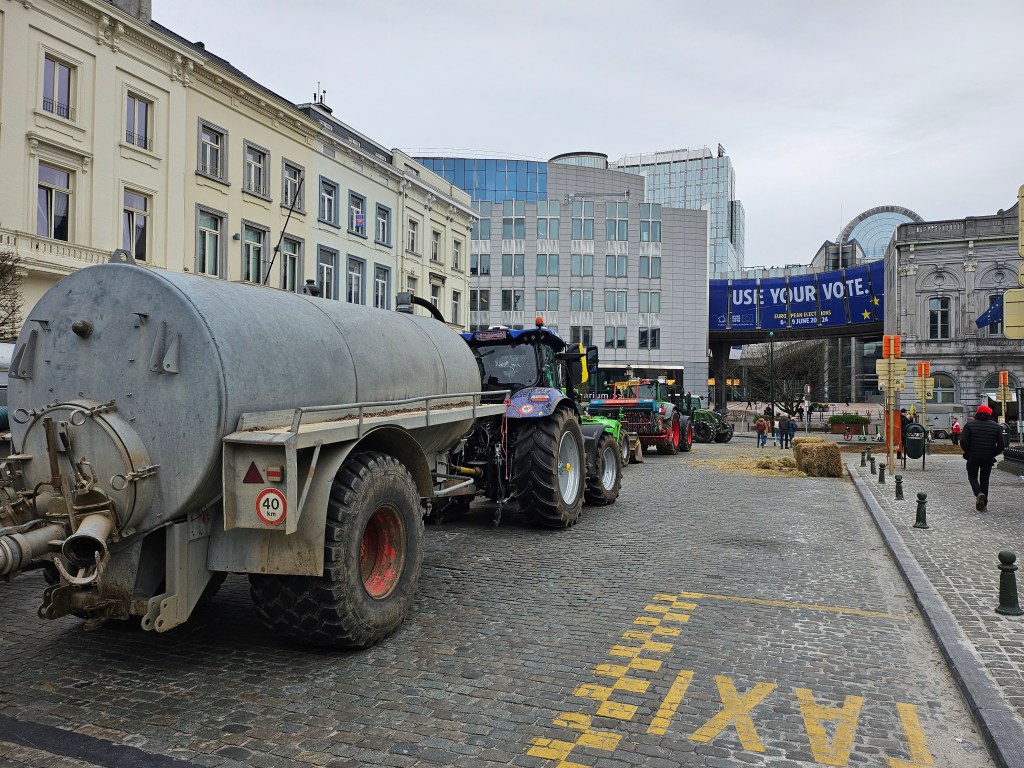
Two kilometres and a world between them, the academics, policymakers and food chain representatives at the FFA conference were speaking about the future of agriculture with little regard for the challenges farmers are facing today. The concept of a food system transition was an environmental strategy where activists, led by green idealists, were imposing practices and rules that work to the disadvantage of those producing our food.
There was only one farmer who was allowed to speak at the FFA conference, and while he was passionate and impactful, after the consultants and lobbyists politely applauded, they then got on with laying out their own strategies on how they would fix what they saw as the problems of agriculture.
Farmers? Who Needs Farmers?
It became clear from as early as the second session at the FFA that farmers were seen as an obstacle to the sustainable agriculture goals – an obsolete problem to be solved. If farmers were to disappear, it would be so much easier for the rest of the food chain consultants and managers to implement their strategies.
Jörg-Andreas Krüger, president of the German conservation group, NABU, boldly declared that the farmers’ protests have pushed their achievements on the environment back several years. How frustrating that must be for him. He also seemed to think that farmers have only now had to learn how to take care of the soil – but farmers have been stewards of the land since they first cleared a patch to farm.
Tech people like Nanna-Louise Linde, VP European Government Affairs at Microsoft, think that AI will have a leading role in the future of farming – that farming will be completely automated. The question of access to this technology is important. Linde says tools already exist. Farmers can now use simple apps to consult experts “without needing to know how to read or write”. This arrogant comment did not go unnoticed by several of the scowling farmers in the room.
But there is a rather interesting question with those looking at developing AI applications: Can we have agriculture without farmers? As data becomes more refined, decisions on everything from the choice of seeds, weed and soil management as well as the fieldwork can be completely automated. Tech developers see this as a reality in the near future and look positively on how it will improve agriculture by replacing farmers (and get those nasty tractors out of our cities once and for all). This is already the case with vertical farming so within ten years, they suppose all farming will be done from a laptop.
Most of the speakers at the FFA get their food delivered to them, prepared and packaged in a box, so automating the actual farming stage is just one more technological advance for the better.
Too many rules and not enough trust…
It became clear to me, early on, how the PowerPoint masters and their bands of consultants have decided to move into the agriculture/food chain to fix it according to their ideals and campaign objectives. Farmers are just the end-users who will need to adapt to the “necessary and inevitable” demands for systemic change.
After lunch, a panel of FFA founding members gave a progress report on last year’s call to action for a sustainable food transition. Everyone spoke about how they are going to help farmers in this transition (this transition was still not clearly defined but it had something to do with improving biodiversity). It was clear though that farmers had to change and become more sustainable. Farmers were not trusted to manage that themselves.
Finally a Belgian farmer, Bram Van Hecke, was given the microphone. But he was not concerned with all of the nice promises from the food value chain. He has surely heard it all before. He wanted to hear from regulators; he wanted to hear why Farm2Fork did not consider farmers’ interests at all. Van Hecke wanted the FFA group developing a call to action on food system transitions to take their advice to governments. In reality, he is simply being overburdened by bureaucracy. “I don’t know any farmer who does not want to protect biodiversity… We are in a situation where we have too many rules and not enough trust”. Bram rightly deserved his long applause.
Screw the Farmers!
In the final session of this conference, Chris Hogg, Global Head of Public Affairs at Nestlé, spoke of how they are promoting regenerative agriculture but that “won’t make a difference unless we can scale it up”. Ok Chris, but are you actually speaking with farmers on whether this is possible or are you just speaking with ESG investors?” Following an intervention from a rather fed up and testy Risk-Monger, Chris acknowledged that he has only interacted with agronomists and researchers.
This reminded me of an issue I had learnt from potato farmers in Canada who were having food brands impose their ESG obligations on them, with no consultation on whether it was possible or profitable for farmers to grow no-till (“regenerative”) potatoes on a large scale. Some researcher in New Brunswick said it was possible and that was enough for the food brands.
Today I came to the conclusion that the food value chain cannot be trusted. Farmers are alone in their fight for fairness and brands and retailers are in no way prepared to give up any of their margins or sustainability demands so those working the land could have a little bit more. Worse, the food brands are making it harder for farmers to produce good, sustainable yields. In a recent Twitter (X) discussion on how gene-edited potatoes allowed Ugandan farmers to produce the same product and yield without the need to use any fungicides, I learnt that this technology had been available to Canadian farmers for a long time but that companies like McDonald’s, fearing a consumer backlash, refused to buy from them, effectively preventing farmers from growing more sustainable produce.
So when food brands and retailers tell us they are providing what consumers want (natural, affordable, sustainable food) what they mean is that they are not willing to stand up for farmers or give them a fair share.
Screw the farmers.
Apple Emissions v Orange Emissions
There was a vocabulary battle throughout the FFA conference between two very overused words: climate and farmer. Most talk of farming at the FFA was about how they would have to transition to more climate-friendly farming. But is this even a fair or reasonable discussion? Are CO2 emissions across sectors comparing apples to apples? The CO2 emissions to grow the ingredients for a loaf of bread should not be compared as equivalents to the emissions from a long-haul flight, driving a large car or some fast-fashion consumption. There are certain emissions (ie, from food production) that we cannot do without and others where more significant emission cuts can be made without affecting the essentials of life. In other words, ag-emissions should not be considered in the same way as other CO2 emissions. Unfortunately, as we had seen with natural gas restrictions, ESG bean counters don’t consider it that way.
The food chain is a significant CO2 emitter and the burden has fallen upon the farmer to make all of the reductions. There is no accountability up the chain, and the farmers have realised that.
Today, after the FFA conference, I went back to Place Luxembourg and the European Parliament. The farmers were beginning to pack up and there was a certain sad resignation in the air. We need more people standing with the farmers. More people need to be telling off the food brands who don’t care about the consequences of their sustainability PR campaigns. If consumers won’t pay more then retailers and brands need to share some of their profits with the farmers. The responsibility for this injustice should not land on governments to rectify.
The real threat to the farmers’ future prosperity lies in the very food chain they form the basis of.
Enjoyed this read (free with no ads)? Support The Risk-Monger via Patreon.
Become a Gold-Monger patron for 5 € / $ per month and get David’s newsletter.
 The Risk-Monger
Thanks for an insightful commentary on issues that farmers face, likely every day. My cousins and their ancestors have been farming the same acreage in Ohio for over 200 years. Contrary to expectations, their yields are increasing because of advances in farming (e.g., no till and glyphosate) and protection of their soil. As an environmental scientist I have come to realize that I am not smart enough to be a farmer, and thank God, every day, for their unending commitment.
LikeLiked by 2 people
so right. Well said
LikeLike