RM: My apologies for the expletive in the title, but the situation is far too late for diplomatic language.
Industry and capitalism have been under pressure for the last two decades via well-coordinated Western activist campaigns, media exposés, regulatory restrictions, relentless legal assaults and ruthless academic attacks. Within many traditional industries, the outlook is grim as a wave of post-capitalist ideologies is dominating the Western narrative.
The very word “industry” has been demonised by this repugnant, vocal (but quite small) activist community of privilege. In the European Union, 99% of companies are SMEs, but the media attention generalises all industry as globalising, exploiting and polluting. Even family farms who use conventional agricultural practices (including building irrigation ponds) have been labelled as industrial farming by a twisted, but relentless, agroecology cult that has glorified a return to peasant practices and handicraft businesses.
I have written frequently with concern about the post-capitalist dogma that the neo-Marxists have been propagating:
- about how activists have taken hold of foundation boards and used them to support groups, NGOs and media to further this objective;
- about how the post-capitalists believe that the spreading of income via trusts and foundations, recently established from the massive accumulation of wealth, is a new type of alternative capitalism;
- about how climate change has become the new wrecking ball to dismantle capitalism via an emerging degrowth ideology that shuns innovation and business solutions;
- about how narrow, dogmatic green energy strategies, particularly in Europe, are destroying the economy and forcing heavy industries to relocate offshore;
- about how there are activist groups, scientists and tort lawyers running multi-pronged campaigns with the sole objective of bankrupting industry and destroying their reputation in the public eye;
- about how industry groups have been excluded from public discourse and policy decisions;
- about how ESG strategies have been stifling growth and development in the name of this new affluence;
- about how activists, tort lawyers and politicians have attacked shareholders to try to undermine the system.
What I haven’t written about is how industry have responded to these attacks to defend their interests, how they have promoted their innovations and presented their technologies and approach as the best opportunity to deal with the present day challenges.
That is because, to a large extent, they haven’t.
Over the last two years, I had written an 8-part series called the Industry Complex. It looked at how industry continues to be attacked by other interest groups and how they have been tobacconized (being treated as pariah excluded from civil society engagement). The “Complex” part examined how industry should be responding and tried to understand why they have not, seemingly content to consider themselves as the second slowest zebra in the herd (happy to live another day). Today the anti-capitalists have succeeded in denormalising the tobacco industry (and the vaping alternative) but their goal is not to stop there. Similar actions have been made to exclude fossil fuel companies from public discourse (with attempts to sue them them out of existence), as well as against crop protection companies, food and drink manufacturers, pharmaceutical and health research organizations, chemical and mining industries… They even published their strategy document.
Every bad research study funded by left-wing foundations with the intent to sow doubt and outrage about industry goes unanswered; every media report showing only the activist side of the argument gets treated as fact; every double standard where NGOs are not transparent on their funding or conflicts of interest are quietly ignored… Those second slowest zebras are grazing as always, seemingly unaware that the activist groups, law firms, media and opportunistic politicians will be hungry tomorrow.
Tomorrow has come much faster than I had expected.
In the spring, I had published a series analysing the World Health Organization’s (WHO) strategy to tobacconise almost all industries. The WHO have broadly labelled them as health-harming industries: from food and drink to pharmaceuticals to chemicals to fossil fuels, demanding that their member states follow the WHO in excluding any contact or engagement with these industry actors. Like the WHO’s FCTC anti-tobacco industry isolation strategy over the last decade, the UN organisation is aiming to denormalise all industries they deem as “health-harming” (which is almost all of them), no longer allowing them a role as a societal stakeholder. We saw the first public example of their new strategy when the WHO’s Regional Director for Africa, Matshidiso Moeti, acknowledged during the mpox crisis in Africa, that she had not had contact with the only main vaccine producer, Bavarian Nordic.
This international organization of overpaid public health bureaucrats thus tries to look busy, have meetings, issue press releases and provide member data about the spread of a communicable disease hitting the poorest of the poor, but have absolutely no input on the measures needed to control the outbreak as they are refusing to communicate with the only producer of the vaccine … because the pharmaceutical company is part of what they have nominally referred to as health-harming industries. This is a vaccine producer and it is sickening to think that the media and policymakers overlook the WHO’s morally offensive “decision by dogma” at a time when people are suffering and dying.
How bad is it for the state of industry in the West when no one is outraged by this travesty? Sadly, not even industry is outraged; they have become used to this treatment. One industry leader from the children’s nutrition sector told me that he cannot remember the last time he was invited to a WHO event.
What Industry has Been Doing?
One thing industry has not done is draw attention or stand up to the anti-industry bully strategy of the WHO (or any other groups who wrongfully attack them). In 2023, when the European Commission strong-armed a private Brussels think-tank, the European Policy Centre, forcing them to expel the European trade association, Tobacco Europe, or face existential isolation, not one industry actor spoke out and the media ignored it (until I “broke” the story two months later). The European Commission justified its anti-dialogue decision on its membership in the WHO and their tobacco industry denormalisation protocol. I understand that the UN is not a democratic institution, but they should not be promoting policies that deny dialogue, public engagement and tolerance. Fascists do that.
Many industry trade associations have become more like quasi-diplomatic bodies that attend meetings and pass on information to their members. They’ll raise a glass to praise the regulators and welcome new policy programmes that will surely castrate their industry and then try to argue around the edges or find a means to apply derogations in order to wrestle two or three more good years for their members. They’ll hold that as a win (and within that time, their careers will have evolved). This constipated policy approach was best articulated in a recent book, European Lobbyists, by Daniel Guéguen.
As quasi-diplomats, they don’t dare to fight back when well-funded activist groups committed to attacking industry, like Friends of the Earth, US Right to Know, Environmental Working Group or Corporate Europe Observatory, openly lie to destroy the reputation of industry. They prefer to rise above than to get in the mud with groups that today hold much more influence within the main media groups. Many of them, like Stéphane Horel or Carey Gillam, are paid by these NGOs but still call themselves journalists.
Industry trade associations are handcuffed by their structure. If one or two members don’t see the point in taking strong actions then nothing can be done (they usually have alternative products that will benefit from the harsh regulations and public fears or actually believe they smell better than other association members). When I worked as a communications manager at Cefic (the European Chemical Industry Council), I could not communicate to the media on the simplest of issues until I had all concerned members sign off on the statement or position. This is why you often see time-sensitive news articles conclude with “The trade association XYZ declined to comment on this news”.
Most public campaigns destroying the public perception of industry are being passed over in silence. Industry trade associations would rather not act than defend the interests of their members even when they are sitting on important evidence that could restore trust. Perhaps the best example of the failure of this strategy was on neonicotinoid-treated seeds and the activist “save the bees” campaign.
In 2014, I leaked a document that exposed a group of scientists who were planning a campaign to ban neonicotinoids. Their strategy document detailed how they would set up a taskforce to ban neonics by working with NGOs and the media to pressure policymakers. They noted how they would find some big-name scientists and find some evidence to show how neonics were affecting bees and publish it in some high-impact journal (Science or Nature) as well as four other strategic papers (this before any research was actually done). This was a damning paper exhibiting the lack of scientific integrity of the activist scientists putting their political ideologies ahead of any existing evidence. My publication of that series (known as BeeGate) was largely acknowledged as a contributing factor in the Obama administration’s decision not to follow the European Commission’s lead in banning the use of seed-treated neonicotinoids.
The sad part of this story is that I was given the activist scientist’s document by an employee of a company who was frustrated by his industry reaction. His trade association had the clearly damning BeeGate document in their possession and chose not to do anything with it. I have leaked other documents that I can only imagine industry actors had seen before me and chose to pass over in silence (for example, the Portier Papers or the German anti-biotech NGOs’ admission of failure on their GMO strategy). Frankly, I’m tired of doing industry’s work for them.
Lemmings … Green Ideology … Cliff
Industry is often its own worst enemy and I sometimes wonder how it is possible that certain sectors employ the brightest and the best straight out of college, pay them top salaries and then leave them to be managed so badly. And industrial management has been at its worst in how they have blindly followed the green, ecological narrative straight to their demise.
The last true industrial titan, Jack Welch, wrote a lot on leadership citing the importance of integrity, intelligence and maturity in the business realm. I am pretty sure Welch never said leaders need to identify the present societal narratives and retool their industries to meet the ideologies of the self-appointed few. Now industry leadership is defined by investment bankers and tech “boy wonders” who are more concerned about amassing personal wealth and doing so by adapting to emerging societal trends.
So when hedge fund opportunists like Larry Fink and David Solomon decided to use the power of their investment institutions to force industries to meet their Environmental, Social and Governance (ESG) flavours of the month, industry leaders not only followed them down that rabbit hole, they imposed them on their supply chains. Rather than leading (or even listening to their clients), they set their bean counters on a tick-box ESG journey with, I assume, the sole objective of keeping their company’s shares in the Fink-Solomon ETF hegemony. It was not clear who was justifying which policies were actually environmentally or socially sound, but the ETFs seemed to be following the narratives and media reports of the day in something I had referred to as a daily ESG Squid Game. The present reactions against the ESG mandates are evidence that industrial management should have led, rather than followed.
The worst example of lemmings on the rampage is the automotive industry. Somebody whispered that electric vehicles (EVs) were the future so policymakers started to announce overly ambitious transition deadlines and created incentives to shift the entire industry from internal combustion engines to EVs in the next decade. All automotive companies began retooling their factories to meet these deadlines. Only Toyota resisted the move to full EVs, and was widely criticised for opting to keep to the hybrid strategy they had successfully implemented more than a decade earlier. None of the leaders of the automotive industry listened to the interests of their customers (except maybe the corporate fleet managers who had some random ESG targets to meet). None of the industry leaders (except Toyota) did anything more than dance to the tune of the ideologically-imposed green narrative. I am not sure how many Western automobile manufacturers will still be operating in the next decade, but very few of them deserve to saved from that cliff they have been blindly marching over.
Did industry leaders stand up to defend access to reliable, affordable (ie, fossil fuel) energy? Did they fight hard enough against regulatory restrictions that were harming not only their viability but also consumers and the environment? Did they take on the activist groups and show how their poorly conceived alternatives would be unsustainable? Did they challenge the Marxist dreamers weaving the post-capitalist narrative (or did they raise a glass in Degrowth Davos)? Did they lead or did they follow, like lemmings over the green cliff?
Jack Welch is turning in his grave as industry leadership has become nothing more than well-articulated green followship.
What Industry Should be Doing
I have also written on what industry should be doing, but as I am no Jack Welch, I am sure I don’t merit the attention of the chattering classes (I’ve accepted that I am merely writing as a curator on the drivers leading to the demise of our prosperity). I defer to the conclusion of my Industry Complex series as nothing has changed and the situation has only become more dire now that the WHO is leading the charge to tobacconise, denormalise and demonise all of industry.
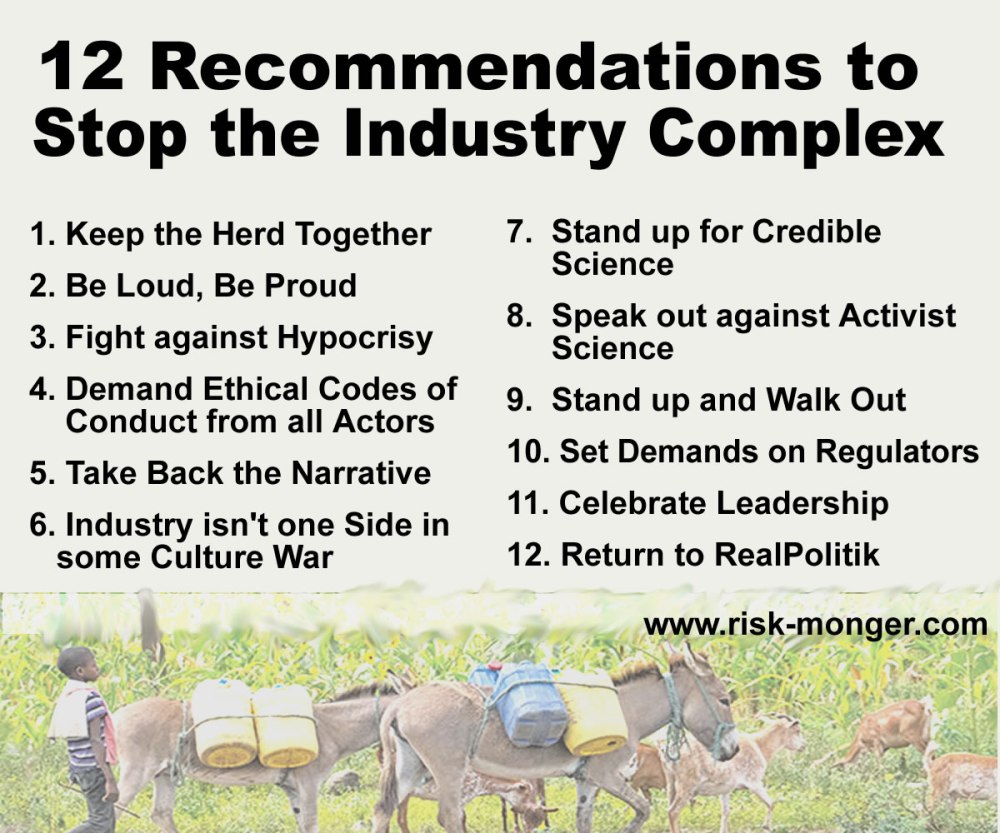
But this needs leadership and the bold leaders I see today are engineering a wide post-capitalist transition (energy, food, transportation, social values…). I only see industry leaders following them (to their own demise). Capitalism will survive and follow where markets, regulations and economies are more favourable (as we find in many Asian countries including nominally Communist ones), but without bold leadership, the future for Western industry, western economies and prosperity is, well, … fucked.
I’m sorry.
Enjoyed this read (free with no ads)? Support The Risk-Monger via Patreon.
Become a Gold-Monger patron for 5 € / $ per month and get David’s newsletter.

