My Inbox is getting busy at the moment with nervous managers from the food industry. Lawsuits are coming in; NGO campaigns are coming in; anti-industry media reports are coming in; and worst of all, RFK is coming in. As the activist scientists, food zealots, health-food lobby and foundation-funded NGOs and media groups are sharpening their carving knives for a roast zebra BBQ, I thought it was an idea to visit some old articles.
Several years ago, I wrote a series called the Industry Complex where I criticised industry groups for their inaction, thinking that, as the second slowest zebra in the herd, their industry does not have to react to what could only be described as an impressively coordinated onslaught against most industries, engineered by NGOs, academics and the media to support their post-capitalist ideology. My conclusions are still interesting today but I thought I should share my observations directly with my friends in the food industry.
My main advice: Look at what pesticide industry lobbyists had done over the last decade, … and do the exact opposite!
The New Tobacco Crown of Thorns
In the recent lawsuit, the food industry has been likened to, no, rather, associated with Big Tobacco. They have been portrayed as getting children addicted to ultra-processed foods and then poisoning them to a slow, painful death of chronic diseases. And what’s ultra-processed foods (UPFs)? Apparently everything now (and why so many confused and frightened consumers have turned to drinking raw milk).
The food industry has to stop thinking they are not as bad as the chemical industry, vaping, plastics, alcohol and pesticides in the downward race to be portrayed as the next Big Tobacco. The food industry now is Big Tobacco with many claims that tobacco industry scientists are being employed by food companies to create addictive experiences, executives carrying out tobacco-like deceptions and tobacco-style marketing campaigns. It is not that they are following the tobacco playbook, lawyers, NGOs and the media are arguing that the food industry has recruited the same players.
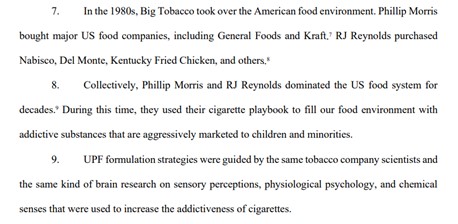
Food industry insiders know such claims are pure nonsense (the tobacco industry had simply tried to diversify in the 1980s and abandoned that strategy two decades later) and this lawsuit will likely not make it to a jury given the strip-mall quality of the law firm. Fine, but if the media, lawyers and activists keep repeating it, those truths the industry hides behind will become pretty damn cold and lonely. What makes matters worse, as much of the tobacco research funding programmes are drying up, I have been told many tobacco-related activist scientists are securing financing for studies intended to raise doubts about food safety. Storm clouds are brewing.
What follows is my advice to food industry representatives. They probably have never heard of the Risk-Monger, never needed to read his assessments or follow his analyses. They probably thought their industry was well-loved and protected by a herd of slower zebras. I can only hope they bookmark this page and get comfortable. From what I see, it’s going to be a rough, rocky ride.
My advice is to first pay attention to the other industries who failed to outrun the ravenous lions. Learn particularly from the mistakes of the pesticide industry whose members are now paying heavily for decades of inaction and misplaced trust in a system that turned on them.
1. Don’t play their game
The pesticide industry thought their trade association representatives were quasi-diplomats who could cultivate relationships with authorities. In Brussels, they watched passively as the regulations, hazard-based and precautionary, systematically removed important crop protection substances. Somehow they accepted the expectation to try to prove substances did not have potential endocrine disrupting properties and, as anticipated, they failed. Time and time again, they were playing a game where the rules were written by environmental activists, chemophobes and the organic food industry lobby. Pesticide management is about reducing exposures (risk management) so it was absurd to allow the main EU regulatory regime (the Sustainable Use Directive) to be hazard-based (where exposures don’t play a factor in the evaluations). I suspect the trade associations saw their objective as to manage the decline and eventual obliteration of the entire crop protection industry.
My advice to the pesticide industry during the very dark days of the Sustainable Use Directive (when people started learning how broken the regulation was) was to walk out, refuse to cooperate in the regulatory process until rational reforms were introduced. The pesticide industry were playing a losing game, and unless the rules were changed and made more reasonable, they were not doing any service to their members, farmers or consumers. They pretended, instead, that they were a valuable stakeholder … and were politely ignored.
For the food industry, I can imagine upcoming regulations will be designed with the intention to hurt food manufacturers. Be very wary about changes to taxonomy on terms like ultra-processed food (a term introduced by activists to denigrate most foods that industry produces) and be prepared to fight tooth and nail to resist letting the food zealots write the rules of the game.
Part of the game is to destroy trust in the food industry. The reason so many juries are awarding unimaginable penalties in litigations against pesticide producers is because, for decades, NGOs have hammered the reputation of companies like Monsanto or Syngenta into the ground. You need the public to trust your researchers, your quality and your commitments. Do not let a group of health activists destroy public trust in your industry – you will be silenced, marginalised and ultimately, denormalised. But to prevent that, you may have to take the gloves off.
2. Take the gloves off
Let’s face facts. The WHO is not going to welcome any representatives of the food industry for a coffee and a warm handshake in their Geneva offices. According to their Non-Communicable Disease Unit’s strategy, you are already persona non grata and the coming attacks on your industry, especially at the Fourth High-Level Meeting on NCDs starting from next May, will make it clear that food companies are the main cause of human health problems. The WHO has classified you as a “Health-Harming Industry” in the same way as the tobacco industry is, with the same proposed restrictions to be implemented.
Michael Bloomberg certainly won’t want you in the same room with him as some WHO agency gives him another award (accolades only his billions can buy).
You need to take the gloves off. Expose how the foundations are funding many of the research papers and NGOs operating under the WHO’s umbrella, and how the media covering the stories (funded by these same foundations) are biased and essentially campaign-driven. When activist groups publish fear-based studies in low-level pay-to-play journals, when low-level academics manipulate data and use poor methodologies, the scientific community needs to speak out … loudly. Do not accept when these activists in white coats get appointed to agencies or institutions and do not tolerate any politically-motivated claims.
The pesticide industry actors thought they would earn respect by being good stakeholders, by playing by the rules and not raising any protest. They would raise their glass to Commission proposals like Farm-to-Fork instead of raising hell. Far too many times, members of the pesticide industry passed confidential documents to me that their trade associations had had in their possession but chose not to use. These damning documents revealed scientists behaving unethically, activist groups scheming with MEPs to push regulations or groups funded by alternatives trying to steal market share. When I released my exposés based on documents the pesticide trade associations chose not to act on, like the BeeGate series, regulators reacted. Many have claimed that information revealed in the BeeGate series dissuaded the Obama administration from following the EU in banning neonicotinoids. If the European trade associations had acted on these damning documents they had had in their possession, perhaps the EU would not have invoked precaution on these advanced agricultural tools.
So the second advice I would like to give to the food industry is to forsake the “good stakeholder and policy partner” nonsense. Activist groups are doing whatever they can to destroy public trust in your industry and if you can expose their ethical and methodological transgressions, policymakers may think twice before trusting them or implementing the NGO’s manifestos word-for-word. If these campaigns are being funded by interest groups, law firms, non-transparent foundations or using activists disguised as journalists, then shout “foul” as loudly as you can. The second-rate scientists these groups are paying off to become their media darlings need to have some transparency shone on them as well. A Ramazzini fellow should be barred from any other scientific institution, merely on scientific integrity grounds.
And don’t rely on people like me to do your dirty work. I have not been very impressed with how certain food manufacturers have treated farmers and value-chain innovations so don’t expect any favours from me.
3. Invest in friends and networks
The food industry stood on the sidelines when the pesticide industry was under a severe activist onslaught. The brands not only did not stand beside farmers and food science, they tried to benefit by promoting and marketing high-margin organic food, advancing the fiction that it was healthier and better for the environment than conventionally-grown food. As second-slowest zebras, you chose to ignore your food-chain colleagues, advancing activist fictions rather than informing consumers on the safety of food technologies. Well, today the food industry is the slowest zebra and I certainly hope your friends and networks will be more supportive than the hypocrites you have been over the last decade.
What the pesticide industry learnt is they could not withstand the constant PR, legal, policy, organic alternatives and media attacks on their own. Everyday, headlines like: “New research finds that Pesticide X (with a foreign, alienating name) may contribute to Disease Y” dominated news feeds, went unanswered and only reinforced the negative narrative. Any scientists who tried to respond with common sense or context were quickly branded Monsanto shills, denied public funding or academic opportunities. With no opposition, ridiculous activist research claims went viral and became reality (often repeated in courtrooms to well-primed, vengeful juries). It got to the point where a benign herbicide like glyphosate (less toxic than many ingredients in cookies) became the assumed cause of dozens of diseases and the poster child for industry outrage. This is what happens when an industry has no friends or networks to support them.
The food industry still has some friends but a similar state of isolation is not too far off. Some examples:
- They still have some influence in the foundation world where much of the activist financing is coming from. They need to work within that community to improve transparency of funding and tools like fiscal sponsorship and donor-advised funds.
- The research community is still balanced in favour of the food industry (with groups like the Ramazzini Institute still perceived as on the fringe, publishing poor junk science). In some fields, like food additives, most of the research has been done by industry and that needs to be promoted, like GLP, as the gold standard. The WHO remains a serious threat to the industry position as they try to legitimise the Commercial Determinants on Health movement.
- The food industry is more integrated into the food chain than pesticides were. With close ties with food processors, farmers, packagers, retailers and health organisations, they have a better chance to keep the herd together as the lions approach. But they need to stop trying to profit from these relationships (like price pressures or ESG impositions on farmers) and cultivate cooperation.
Of course the food industry can continue to operate business as usual, ignore the looming threats and assume their marketing machinery can manage the fallout (call this the “Coke Strategy”). But I say this now, with more than 20 years’ experience dealing with these zealots: do not then expect that we will be consuming food in the same way within the next decade, from the same companies. Your industry will be forced to change and you will have little input in the process except, maybe, to organise a managed decline.
4. Learn how to deal with the zealots
Zealots are sociopaths with no moral compass and a relentless passion to win. RFK Jr is a good prototype. People have come to regret the assumption that this little militant could be ignored as he would just fade away under the weight of facts and evidence. Impassioned and indefatigable, there is no way to compromise with zealots who look at concessions as momentary interruptions. Do not expect fair play or cooperation. They are relentless and need to be contained in small boxes … drained of oxygen.
Do not give these activists air within the food debates as they will take it all and suffocate the room. For pesticides, we saw how, with the Monsanto Papers (and recently, the Lighthouse Reports “exposé”), these groups can take a little point, blow it up and lie to no end across their networks of ethical hyenas, creating a feeding frenzy on the carcass of an industry. Carey Gillam is a good example of a zealot opportunist who fed voraciously on the festering pus of Monsanto’s reputation, profiting lucratively from lies no one bothered to confront. This sociopath had no ethical qualms about spreading falsehood (she has been working closely with tort lawyers) and was given far too much oxygen. Carey should have been sued into oblivion when she first started generating fictitious claims more than a decade ago, but the crop protection industry was worried about what such an action would do to its reputation (I wish I were making that up).
The food industry needs to keep such sociopathic opportunists in an hermetically-sealed box, controlled and restricted. Mathilde Touvier seems to be the best example of a nutritionist zealot who is spreading fictitious claims and half-truths to advance her media celebrity. A couple costly years for this relentless Carey 2.0, in front of juries presented with clear evidence, may temper her recent opportunism.
One final tactic that is rarely utilised today is the Orwellian approach of turning one zealot against another. Activists excel at presenting campaigns with a single voice, on message and tightly packaged, but there are often important differences and interests bubbling below the surface. When I was working on REACH at Cefic two decades ago, there was an EU demand for new data that would imply a large increase in animal testing. This also outraged the animal rights groups who suddenly, and accidentally, were allied with the chemical industry in protest. Greenpeace zealots are not afraid of taking the fight to industry (it emboldens them) but the NGO was wise enough to back down when even more extreme activist groups were sharpening their spears and pointing at them.
The food domain has many subgroups where people are passionate about their alternatives and won’t tolerate any threats from the mainstream zealots. Specialty diets, allergy groups and sports performance advocates won’t take kindly to any attempts to restrict food processing or packaging. If you can’t suffocate the zealots, then distract them.
Lastly and most importantly, the food industry needs to control the zealots within. There will always be opportunists inside the food industry who try to capitalise on public fear to grow their markets, dividing the industry for some short-term gain. Not only does their marketing hurt public trust in food safety, they also weaken trade associations who are welded to policy initiatives according to the lowest common denominator. I have referred to this as “Competitive Manslaughter” and it can destroy industries. So when a group like Chipotle tries to run a campaign that attacks the food chain, they should be thrown out of any trade associations working to promote public trust in food safety.
The reality though is that the food industry is not united and does not see the looming risks as a serious threat. They assume, like past cases, they can just lobby their way out of the present situation. Old thinking for an old industry unwilling to change. I hope someone in middle management in some brand division of some conglomerate bookmarks this article. After four years of mass tort litigation chopping off your legs and Robert F Kennedy Jr taking a chainsaw to your head, that middle manager may be one of the last people standing in the industry.
The lions are approaching.
__________
Enjoyed this read (free with no ads)? Support The Risk-Monger via Patreon.
Become a Gold-Monger patron for 5 € / $ per month and get David’s newsletter.
 The Risk-Monger
Thank you for this comprehensive thundering polemic Mr Monger. The comments on copying the “Big Tobacco” activist lawfare approach are well described, involving the usual ad hominem attempts to discredit proponents of contrary evidence, and advocating the usual prohibitionist bullying attacks on the Three As: availability, affordability, and advertising. Producers of legitimate consumer goods must challenge the legal and ethical authority of activist anti capitalist zealots to interfere in their operations, including litigation to redress losses and abuse of legal processes.
LikeLiked by 1 person
Further to the Tax Pets article, it’s a dog’s life https://burburyhotel.com.au/package/pooch-package Ruff. 🐶
LikeLiked by 1 person
From what I have read about RFK Jr, some of his ideas are worth looking at. Vinay Prasad explains this viewpoint at https://www.thefp.com/p/rfk-jr-health-human-services-flouride-vaccines-covid-trump-europe?utm_source=youtube&utm_medium=organic-social
LikeLike