An Essay on the Individualisation of Communications
More than a decade ago, I began a series called How to Deal with Stupid. I had never imagined then that we would get to the point, especially in the United States, where not only do facts not matter, where lack of expertise is celebrated in government health and research agencies, and where MAHA Moms are dictating policy and sharing their wilful ignorance on science and common sense on mainstream American media news shows. How did we get so misinformed, so fast and so wilfully? We cannot just blame COVID.
I had a conversation this week (with a real person!) on this question while discussing how the MAHA Strategy Report has cemented a series of crackpot conspiracy theories (5G, raw milk, fluoride…) as the objective for US scientific research over the near future. What I found most remarkable is that this official White House government policy strategy document, less than 17 pages, was not read by any of the mainstream media. They only reported on the outrage within the MAHA Moms movements that RFK Jr did not go far enough.
I pulled out my old communications professor notes and gave a brief history on the individualisation trends of our communications tools and the subsequent effects it has had on how we trust (sources of) information. See a series of articles I had written on this problem going back to 2017-18. It might be an idea to review this history in trying to understand how “stupid” can be so easily unleashed on what was assumed to be intelligent societies and individuals.
The Individualisation of Communications
The communications tools we have access to determine not only how we acquire information and knowledge, but they also shape our narratives (how we perceive the world around us that houses this knowledge). The stories we tell are only believable if they fit into these narratives. Every communications revolution, every new communications technology, has led to major socio-economic and cultural shifts, often with a brutal confrontation between the old and emerging institutions of the day. And with every comm-tech upheaval comes a new trust dynamic: whom we trust and how. Likewise, if there is no trust, there is no successful communications.
This story starts with a monk tucked away in a monastery tower.
The Printing Press
Prior to Johannes Gutenberg’s invention of movable type (between1440 and 1450), there was only one book known throughout the Western World, the Bible. The message was communicated from above, via the Catholic Church, which dominated a societal narrative imposed from the heavens. The message transcended man and structured the universe with a loving, all-powerful deity as messenger. The communications were collective and cosmological. Those who would dare challenge the message (or messenger) would be excommunicated (or worse). Trust was built around the will of our Lord (fate) and we bowed to the power of His will (via the Church).
Gutenberg developed the printing press to ease the burden of these poor monks laboriously transcribing the scriptures by hand, making the Bible more readily available. Little did he understand how it would crack the authority of the communicator, the Catholic Church. When Martin Luther, for example, nailed his 95 Theses to a church door in Wittenberg in 1517, he was merely passing a message up the conventional communications chain. But when someone printed up a few hundred copies of his criticism of the free market on indulgences, the Church had lost its authority to control the message and soon, this main institution of the day had lost the cosmological trust it had assumed from the Scriptures. The Protestant Reformation had begun to change humanity’s relationship with the deity.
It did not take long for others to challenge this institutional authority. Francis Bacon published his book, the Novum Organum, in 1620 and soon this new science was born, challenging ideas and developing a knowledge that had been suppressed by the Catholic Church. Many of the great works of Antiquity were “reborn” during the Renaissance and a rational methodology developed during the Enlightenment. These printed books were widely read in universities rather than restricted to theological centres. While most people were illiterate and relied for their information on the religious institutions and an aristocracy that sought a Divine Rite to rule, a small but growing intellectual population (the experts, scientists and philosophers) was starting to influence trade, politics and research. The French Revolution in 1789 marked the most important political transition that started with the printing press.
These messengers (philosophers and scientists) were trusted on the basis of their knowledge and expertise. Trust then had descended from a cosmic deity to trusting the experts in the emerging scientific fields (although still collectively communicated through academic institutional authorities then controlled by certain political classes).
Radio and Cinema
Radio and cinema technologies started to be widely available in the 1920s and 30s creating a more immediate and emotional impact on populations than books or newsprint. The public had difficulty differentiating the content from these technologies from reality (sound familiar?). During Orson Welle’s radio show, The War of the Worlds, members of a small-town community shot up a farmer’s water tower believing there had been a Martian invasion. Around the same time, in Germany, Joseph Goebbels recognised the power of cinema to manufacture a belief system contracting films like Leni Riefenstahl’s Triumph of the Will or Olympia to propagate a message that could indoctrinate a public into accepting his alternative reality. This was not accidental. In his diaries, Goebbels had criticised British and American films for not fully exploiting the propagandic power of cinema.
Side note: Prior to the end of World War II, the verb for the diffusion of information was to “propagate”, but after Goebbels, this term fell into disrepute and, interestingly, linguists adopted a term from old French: “to communicate”, which had been previously limited to describing how men and women interacted in private.
For the first time, communications technologies could be used to manipulate public reactions in real time with the use of cinematic news reels, radio fireside chats, films and entertainment, allowing leaders and influencers to come into people’s homes and build relationships with them. Music, intonation and sound effects could be added to manipulate the message. Whomever controlled these media, controlled the messages.
The communications authority moved from the cosmic to the expert (institution), and now to the leader/influential figures that had control of radio and cinema. These leaders were able to control public trust via immediate, emotionally-reactive tools as communications (propaganda) technologies starting to be seen as powerful means to mislead and control populations.
Television
The widespread growth of television in the mid-1950s brought several further shifts in the communications individualisation revolution. Sponsors and advertisers created the growth of a new influential force in media and led to a rapid rise in consumerism (consumption). Growing in economic strength, these corporations used science to innovate new products to sell to a progress-obsessed culture. They also represented a shift in the institutional power dynamic. See Edward R Murrow’s speech criticising the networks for not broadcasting an important speech by President Eisenhower because it would have bumped popular “prime-time” TV shows off the air. Were the sponsors more powerful than the President?
As well as the new institutions of the corporation and a progressive science, this emerging communications tool also advanced the status of the celebrity, giving TV stars the power to influence their generation from the comfort of their living rooms. In the US, Walter Cronkite, Marilyn Monroe, Rock Hudson, Elvis and Ed Sullivan created a new type of influencer. The general public trusted them and aspired to be like these celebrities (if anything, to have their wealth to afford all of the consumer products being advertised to them).
The messenger communicating to the public was further individualised with the emergence of television, with the influencer being people like us, speaking to us in our language. We trusted them more than leaders, sometimes electing celebrities to government on that basis. Television rocked the political institutions in the 1960s as the Baby Boom generation had found its voice via this new, powerful communications technology. We also trusted corporations speaking to us in those 30 second ads, assuring us that if we buy their products, we could be better … we could be famous! Flattery and aspiration accompanied this new driver of trust: familiarity (we trusted people like us).
The Internet
Of all of the communications revolutions in history, none has been as significant as the digitalisation of all knowledge and information – the Internet. Today every person carries more literature, research, history and information in a pocket-sized device than what exists in all of the world’s libraries combined. It still astonishes me that anything we want to know is now available, freely, within a few taps and clicks. Access to knowledge, however, does not make us smarter nor has it necessarily made life better (some would argue the opposite has happened).
Because there was so much information available, it needed to be sorted and ranked (with Google becoming the influential arbiter controlling the information flow). Information became moulded, with groups, websites, organisations manipulating the “Information Superhighway” to control the public narratives (what supported the public belief systems that supported which stories we heard). In the early 2000s, I remember the months spent trying to increase the number of links to my science communications website to work our way up Google’s search engine optimisation scorecard of the day. Newspapers and mainstream media groups lost influence to smaller, online news organisations that were more targeted, cheaper and closer to their audiences. Podcasters, influencers and commenters further democratised the messengers controlling the information flow.
Activist groups were more tech-savvy then, so the main institutions of the day to suffer from the Internet communication revolution, science and corporations, lost power and influence through a relentless series of campaigns spreading fear and doubt on environmental-health issues. The messages widely communicated to the public was of a planet in peril, public health decline with a constant series of threats to humanity controlling the societal narratives. The process of individualisation of the communications process furthered with the demand to get involved to fight these threats to humanity, to take action and join the NGOs fighting for the victims. Citizen panels and citizen science from these online communities were proposed as a viable alternative to the untrusted government regulators.
Trust in governments, science, industry and large media groups was eroded, and while large NGOs enjoyed a relative trust surplus, the first decade of the 2000s was best depicted as the Post-Trust Society. It should come as no surprise that mental health issues, substance abuse and social issues increased dramatically during this period. From this void, a new driver of trust was born – me. Agency became the most important means to create trust with individuals. For me to trust you or your product, you would have to provide the necessary information (eg, via a product label or website) so that I can decide if I can trust you (give you my buy in). If you are not transparent, I cannot trust you.
Social Media
When social media sites like Facebook, twitter and YouTube became popular in the 2010s, they seemed at first innocuous. But if the digitalisation of all human knowledge were not a severe enough revolution, the socialisation of this knowledge proved to have even a greater impact on Western culture. It was no longer necessary to sort out information according to a myriad of sites that had more influence via search engines, activists and media groups. Rather, we now had algorithms that acquired our personal data and could sort us out into groups of individuals that believed the same things as we did.
We no longer read the same book (the Bible); we no longer listened to the same experts or institutions; we no longer followed the same leaders; we no longer desired the same celebrities or consumer products; we no longer watched the same news programmes or visited the main news sites… with this social media communications revolution, we only listened to (and influenced) people who thought like us. This is the completion of the individualisation of our communications tools – we now only interact with people like us. Anti-vaxxers never need to interact with health authorities, chemists will never consult chemophobes, and climate activists have cleansed their discussions from sceptics. Dialogue and debate have been purified from confrontation.
The best way to describe the Age of Stupid is not that there are so many misinformed people, but that we lack the means to hear other views that might correct our own illogic or misinformation. There is no dialogue in an hermetically sealed echo-chamber. If everyone I come in contact with agrees with me, how do I know that the things I believe in are actually correct? How do I know that I am not the stupid one?
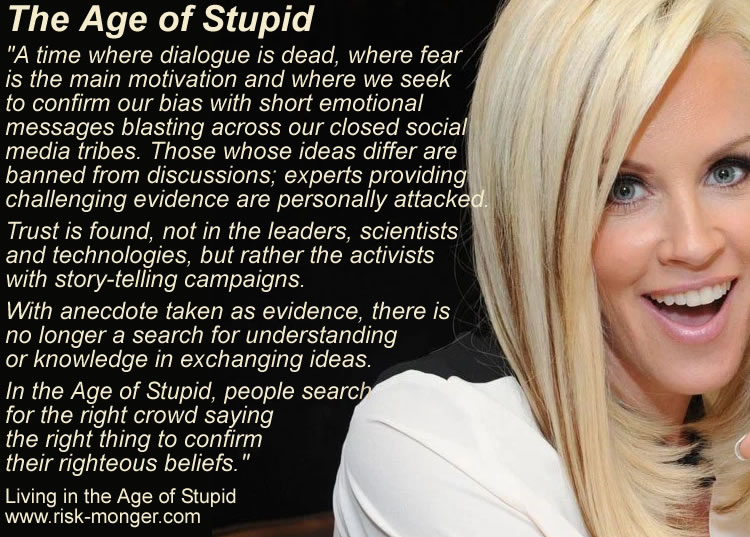
There are no institutions that matter anymore, no social contracts to bind society together or any shared narratives. I exist in my own world with my own followers. My reality is never challenged by other ideas and the silos of confirmation bias ensure that I am never confronted with other realities. Trust is only found in people who think like me and I am rarely, if ever, exposed to anything that would interrupt this world. Reality is built within the silo the algorithms have led me to and locked me in. Ignorance and misinformation is perfected in that there is no one in this reality to inform me otherwise. Social media has brought me into this Age of Stupid.
So how did we all get so stupid? It all started with that monk tucked away in a monastery tower.
Postscript: And you Thought it Couldn’t Get Any Worse
The timeline for these communications revolutions playing out moved from millennia to centuries to decades to years. I have been blessed with the opportunity to have not only been a spectator in the most important communications revolutions in the history of humanity but to have also been actively involved in a few of them. We are now sitting on the edge of the Artificial Intelligence (AI) Age. And while I am drinking up as much as I can during this revolution, I am merely a spectator now in a process I fear cannot be controlled.
The individualisation of the communications process has been completed (from the messenger moving from deity to expert to celebrity to the individual like us) so the next logical step is to remove the individual from the equation (and remove industries, currencies and societies). The bot on our device will be the messenger and as our level of ignorance and social isolation will have reached its zenith, we will not realise how our control over reality has been externalised.
It seems we have come full circle. We now submit ourselves, in blind trust, to a new deity that controls the message – the data (and whomever is training our models).
I’m sorry, but I don’t have the processing power to make sense of what happens next. Just please follow this one piece of advice: Hug someone close to you. Let them know you’re there.
—-
Enjoyed this read (free with no ads)? Support The Risk-Monger via Patreon. Become a Gold-Monger patron for 5 € / $ per month and get David’s newsletter.
 The Risk-Monger