Here we go again.
Last week a WHO scientific body, the International Agency for Research on Cancer (IARC), published Monograph 140, releasing its initial findings on the herbicides: atrazine and alachlor, and the fungicide: vinclozolin. Given that IARC performs hazard assessments, which lack any real world exposure considerations, it was no surprise that they found these pesticides, in the case of atrazine, to be probably carcinogenic (Group 2A). Importantly, that is enough for the US litigation industry to start harvesting plaintiffs from late-night TV ads to build up an extortionary force large enough to extract a settlement with the atrazine manufacturers.
The entire glyphosate tort extortion racket, costing Bayer billions of dollars in settlement fees, was based solely on the IARC monograph system, the only scientific agency to have determined that the widely-used herbicide might be linked to a certain type of cancer. Four of the US scientists to have served on the IARC glyphosate monograph earned millions of dollars as litigation consultants in the lawsuits that followed. IARC destroyed its reputation a decade ago as its leaders willingly threw themselves into the nasty politics and activism coming from their publication. See a series of articles here and here.
But the story today is not how atrazine was determined to be probably carcinogenic. IARC’s hazard assessment approach guarantees that. It is not that the US tort law system will use this glorified literature review to amass hundreds of thousands of plaintiffs processed through the system to serve as numbers for negotiations to secure out-of-court settlements with atrazine manufacturers. Like other IARC monographs (glyphosate, talc, aspartame, gasoline…) the litigation industry was likely behind this publication via the hand of Ramazzini. Rather, the story is about how IARC, after so many years of ignoring legitimate criticism from the scientific community, is trying so hard to make their pitiful monograph seem relevant.
Oddities in their Monograph Release
Like every monograph, IARC publishes their initial findings in the Lancet (the one journal they can feel certain will never retract their articles). As a science communicator with almost three decades under the belt, I found it interesting how this esteemed global research agency was working so hard to embellish their findings and present their hazard assessment as a legitimate document coming from serious research.
The first line of the IARC Lancet publication already set off alarm bells. “From October to November, 2025, a Working Group of 22 scientists from 12 countries met…” That leads me to believe that 22 scientists spent two months labouring over the thousands of documents and research data. Impressive.
Well, not really. These scientists (or at least those who actually showed up) met from 28 October to 4 November 2025. Technically these dates are “from October to November”, so IARC is not lying, but there is a big difference between meeting for one week instead of the implied eight weeks. Like many things IARC produces, this was deliberately misleading.
Seeing how they were up to their old tricks again, I realized it was time to get over my IARC PTSD and take a closer look at Monograph 140.
IARC’s Activist Scientists
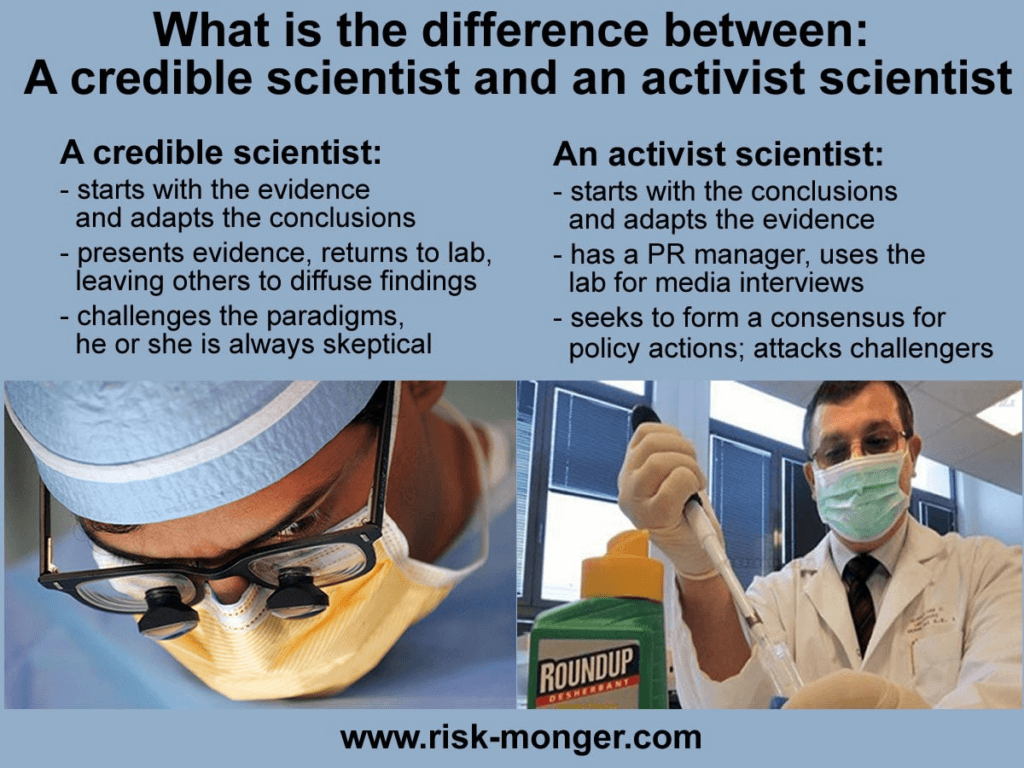
Eleven years ago I coined the term “activist science” to demonstrate how manipulative certain researchers have become. A respected scientist would gather evidence and draw conclusions. An activist scientist would start with conclusions and look for evidence. IARC started with the conclusion that atrazine is a carcinogen, and then hunted through the literature for positive findings to prove their point.
“For all other cancer types considered, the available studies in humans did not show consistent positive findings, and the evidence was considered “inadequate”.
So the IARC panel was simply searching to prove atrazine is a carcinogen. That is why their panel experts were called to spend a week in Lyon during the local wine festivals. They were not going to try to falsify that conclusion to test how robust it was. Adequate is good enough.
Respected scientists will take any claim and try to disprove it (Popper’s theory of robust hypotheses resisting falsification attempts). An activist scientist will take that claim and declare a consensus (with those that agree with them) and robustly attack anyone who dares challenge that “consensus” of 22 self-appointed IARC monograph panel members. Did these monograph panel members critically analyse those few studies that gave them their coveted “carcinogenic” conclusion?
IARC is incapable of healthy scepticism. Ten years after their Monograph 112 declared glyphosate probably carcinogenic, against waves of scientific and political backlash, IARC has refused to retract or re-examine its conclusions even given how the agency’s findings had been so abused by chemophobic NGOs and tort law firms. Rather, the few IARC panel members still defending their review have benefitted nicely, serving as high-paid litigation consultants. It was all in the Predatort gameplan.
Respected scientists should experiment to test their hypotheses. The activist scientists at IARC have experimented with simplifying their literature review process with a checklist approach. This most recent monograph is a good example of how IARC is implementing their Ten Key Characteristics of Cancer checklist as the basis for their research and conclusions. I have written before (here and here) how IARC’s Ten Key Characteristics approach would conclude that any substance is a carcinogen.
“There is “strong” mechanistic evidence that atrazine exhibits key characteristics of carcinogens (KCs).”
IARC reached its decision of atrazine being probably carcinogenic based on studies that showed evidence of oxidative stress, inflammation, immunosuppressive qualities… and other “key characteristics” of carcinogens that, on their own, meant very little.
The checklist approach, now the basis for IARC’s conclusions according to their Lancet press release, does not actually prove anything. There are many substances that are, for example, inflammatory, but not carcinogenic.
The Ten Key Characteristics checklist is meant to simplify the carcinogen determination process, but at this point, if all you want is a scoring checklist, why not just use AI? I asked my AI bot if atrazine was a carcinogen and I got a far better and far more reliable answer than what the activist scientists at IARC took a week to conclude.
But IARC’s conclusions were already baked into their corrupted process. What did IARC do to try to get the public to believe them? Now it gets absurd.
Communications Designed to Manipulate the Public
The press release came with a nicely done infographic (see below) to make sure that non-specialists (those who did not understand the how the Key Characteristics checklist worked) got the message that these pesticides were carcinogenic. The intended audience for this infographic was the media, policymakers, NGOs, MAHA moms, tort lawyers and potential jurors. The image is freely downloadable for these activists to use in their communications campaigns. But sorry to ask: Was this what IARC’s monographs were intended to do?
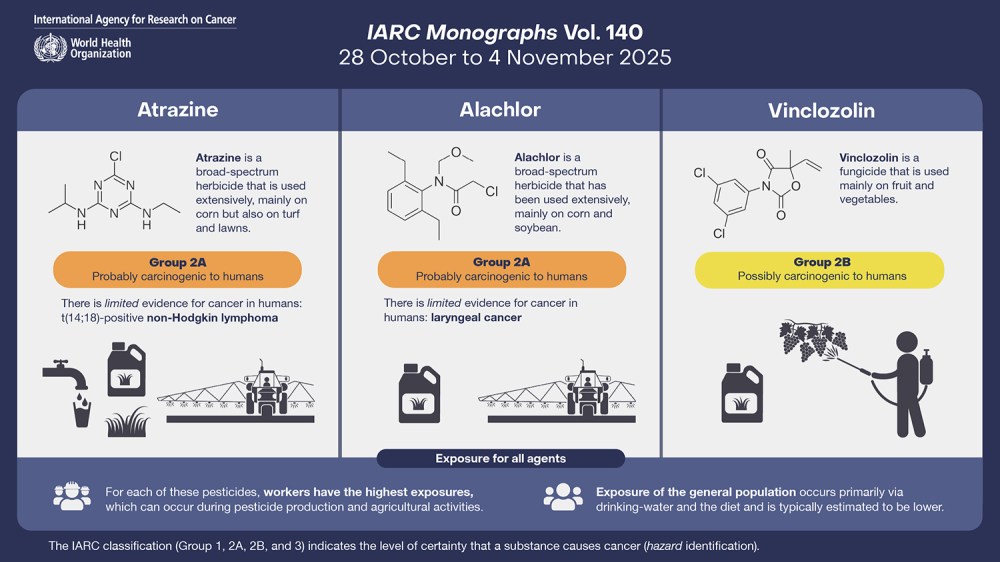
IARC’s monograph programme performs hazard assessments. These studies only check if a substance or practice is a hazard (Yes or No). It does not consider levels of exposures. Risk equals hazard times exposure, so if regulators wanted to determine any real-life risks from these substances, they would need to measure exposure. Glyphosate residues, for example, found on your oatmeal might be considered a cancer hazard (but even at IARC’s low bar, this was still questionable), but at the detected exposure levels, consumers would have to eat two hundred boxes of cereal a day to put themselves at any risk. In other words, relax and enjoy your oatmeal. The same can be said about this latest selection of pesticides that the IARC hazard assessment declared to be carcinogenic.
The role of these IARC monographs is to provide a baseline if something is a hazard, which then would perhaps motivate regulatory risk scientists in national governments to examine exposure levels (for consumers, users, the environment…) to determine if there is significant evidence to introduce risk reduction measures (labels, exposure limits, bans…). In the case of glyphosate, not one government risk assessment agency agreed with IARC about the carcinogenicity of the herbicide because they were looking at real-world exposure levels.
Those outside of the scientific world don’t understand this distinction between hazard and risk so the manipulative bastards in the litigation industry, the media, the Ramazzini world of activist scientists and the chemophobic NGOs regularly take advantage of the general public’s ignorance to advance their own, lucrative, self-interests.
But IARC know this distinction and know the agency is at the service of its member states’ scientists who fund their monograph programme to produce hazard assessments for their national risk assessors to take into consideration. These monographs are only of use for regulatory risk scientists.
Given that IARC’s work is intended for research specialists, why in God’s good name then did IARC prepare an infographic for non-specialists when the only purpose of their hazard assessments is for the scientific community to consider further research. The short answer is because the activist scientists at IARC are working directly with those manipulative bastards and are profiting from them. Don’t get me started on the long answer.
As the Americans are pulling out of the WHO, and probably IARC as well, it is time to shut their dreadful, manipulative monograph unit down (especially before they their upcoming panel on cannabis declares the obvious).
Since 2018, SlimeGate has been one of the few documents, a living research text, trying to expose the corruption and lies behind the litigation industry. If you enjoyed this read (free with no ads) or the entire SlimeGate exposé, why not support The Risk-Monger via Patreon? Become a Gold-Monger patron from 5 € / $ per month and get David’s newsletter.
 The Risk-Monger