There has been a Cold War going on over the last two decades between the two regulatory superpowers: the United States and the European Union. Their conflict has dominated international trade and public policy in emerging markets and developing countries in Africa and South-East Asia where trade and development depended on which regulatory and market approaches were adopted. This Regulatory Cold War left a trail of victims from peasant farmers to small manufacturers, affecting food, energy and resources locked in global supply chains across free-trade oriented regimes.
The European Union has been trying to impose a hazard-based, precautionary, value-based approach on developing countries. If your country or industry wants to trade with the European Union, you would need to transpose EU regulations on pesticides, chemicals, CO2 emissions, waste management and seed technologies. Meanwhile, American regulators have been promoting a more risk-based, evidence-driven regulatory approach pushing for free markets in developing countries open to innovative technologies and industrial development (via their industries).
Since the time of REACH, the EU chemicals regulation, both regulatory superpowers have been fighting to impose their laws, codes and standards on developing countries and emerging markets to promote their key industries and make their businesses more competitive. Some examples where the two superpowers in this Regulatory Cold War have been locking horns:
Agrotechnology
From the European perspective, if there were traces of a banned pesticide or if the agricultural product exceeded the excessively stringent maximum residue levels of a permitted plant protection product, then exports would be halted. There is no flexibility here (except perhaps to allow European chemical companies to export pesticides banned in the EU). It is unknown how many children in Uganda and Kenya died due to the avoidance of spraying walls with DDT to kill mosquitoes that carried malaria (after a thoughtless communication from an EU RELEX official suggesting drift onto nearby crops could threaten exports).
As there is confusion among agricultural groups in developing countries as to what is or is not permitted for export to the European Union, many are just adopting or transposing EU agricultural regulations or, worse, embracing agroecological farming ideologies promoted by activist groups and foundations (that have manipulated the FAO with anti-technology funding programmes).
Americans meanwhile were pushing regulators in developing countries to accept genetically modified seeds and gene editing and to have their markets open up to US agricultural products and technologies. Recently governments in Nigeria and Ghana approved seed innovations without the regulatory obstacles similar efforts had encountered in countries like Uganda and Kenya. These regulatory battlegrounds came to a head when the Zambian government, after a devastating flood, refused to accept US food aid (genetically modified maize) for fear that a farmer might plant some of those seeds and subsequently threaten all future export possibilities to the European Union. South American farmers were not so easily extorted by European regulatory expansionists and have fared much better.
ESG and Supply Chain Due Diligence
The last European Commission administration further tightened the screws in the Regulatory Cold War with two Directives known as the Corporate Sustainability Reporting Directive (CSRD) and the Corporate Sustainability Due Diligence Directive (CSDDD).
- The CSRD is also known as the ESG directive that aims to enshrine Environment, Social and Governance guidelines into regulations applied to all companies. American companies trailed European companies on several of the ESG metrics (like energy and labour standards) and as in-house ESG standards were receiving public and investor blowback in the United States (well before Donald Trump’s return to the White House), the ESG Directive was intended to give European industries a first-mover advantage.
- The CSDDD or Due Diligence Directive codified demands to verify best ESG practices throughout the supply chain including businesses operating outside of the EU, ie, in developing countries. This forces global manufacturing that may export to the EU to adopt European environmental and ethical supply chain standards. These codes already existed in certain EU Member States like Germany, so transposing them to the EU level (and globally) did not affect EU industry to the same effect as businesses operating outside of the EU.
The tactic of imposing regulatory restrictive standards on the global supply chain was established two decades ago with the REACH chemicals regulation that became the universal standard for the use of chemicals, giving European companies a compliance advantage in international trade and operations. Were these regulatory benchmarks rational, science-based or economic? That question doesn’t matter if an organization somewhere in the supply chain hopes to export any substance to the European Union.
While the CSRD and the CSDDD Directive implementations have encountered a few obstacles following the 2024 European elections (mainly referring to the size of companies that will need to comply and within which timeframe), the European Commission is still pushing forward despite the decline in interest of the ESG marketing fad.
Energy and Climate Change
In the early days of the Regulatory Cold War, the European Union championed the Kyoto Protocol to reduce greenhouse gas emissions (while the United States pulled out of the accord during the first George W Bush term). This strategy was spearheaded by France, a country whose electricity then came mostly from nuclear power. Any carbon emission trading schemes in line with the Kyoto goals would have been to the European Union’s competitive advantage.
The European Union’s Green Deal has dominated global energy policy decisions from carbon emission disclosures to choices of energy sources for development projects. From emission trading schemes to potential carbon taxes, the European Union was trying to impose its climate strategy on the rest of the world. Europeans were trying to use its lower carbon economy and lead in renewable technologies to its advantage while subsequent American administrations were locked in a largely fossil-fuel based economy.
The global energy mix was disrupted by European ambitions of developing green jobs in a new green economic-industrial revolution, be it French nuclear reactors, Danish wind power or German solar panels (later offshored to China). While other less affluent, less subsidized markets were struggling to provide affordable (fossil fuel) energy, Europeans were playing the climate card to try to promote green economies across emerging markets. Prior to the second Trump administration, Americans, late to the game, were trying to play catch up with the development of renewable energy, but the European and Chinese industries were leading the race.
Without a Capital Markets Union, the EU lacks the significant financial base for large renewables infrastructure investments. They compensate through subsidies and taxation, something less available in developing countries. But these countries are also wary of an eventual EU carbon tax (via the Carbon Border Adjustment Mechanism) slapped on them should they invest in fossil fuel energy projects.
The End of the Regulatory Cold War
Like the revolutions of 1989, the Regulatory Cold War ended rapidly with the Trump administration’s complete capitulation. In looking inward, in cutting programmes like USAID, in breaking up the global trade and diplomacy system, the US government no longer has any influence on regulatory systems in developing countries. Quite simply, Trump doesn’t care what other countries do on their soil, so long as companies or advanced economies invest in American manufacturing and factories in the United States.
How did this Regulatory Cold War crumble so fast?
- There is no longer a question of free trade or a global economic system given the American isolationism and tariff strategy so other countries are now no longer pressured to adopt or bow to US regulatory pressures in their own lawmaking.
- There is no USAID or other American trade and development programmes to try to influence policy on the ground in these emerging markets. Many advances in African ag-tech had been with the cooperation of USAID activities.
- American companies no longer have US diplomatic support to open up new foreign investment opportunities for US companies. To the contrary, American businesses that invest outside of the United States, like John Deere, risk sanctions via a wag of the President’s pen.
- Trump’s tariff policy has driven a wedge between the US and its allies. Many other countries (like India, Brazil and China) are effectively abandoning trade negotiations with an increasingly erratic American leadership. The recent Shanghai Cooperation Organization (SCO) Summit in Tianjin, China and the expansion of the BRICS trading block demonstrate a new alternative to global trade and policy strategies.
- US banks and asset managers pulled out of the myriad of net-zero alliances and carbon reporting schemes when Trump returned to the White House. Just yesterday, a Dutch pension fund, PFZW, broke off its relationship with BlackRock for their failure to comply with carbon reduction investment targets. Will these net-zero targets matter in developing countries?
- And, most importantly, the process of dedollarization has started, diminishing the role of the American economy and financial institutions leading to a likely further weakening of US influence in global policies.
It is quite remarkable how one man has been able to destroy all of this in just eight short months. American Exceptionalism has quickly become Except Americanism.
The Spoils of War? Not Quite.
The European Union then, as the sudden victors in this Regulatory Cold War, is free to impose its precautionary regulatory handcuffs on the developing world and dominate the North-South trading system.
But before Brussels plans a victory parade, we need to ask how glorious the victory really is.
- The EU is struggling under a leadership vacuum and its own policy revisions (on the Green Deal, ESG, due diligence and carbon emission trading).
- There has been a decline in EU influence in the developing world (mainly to China and Russia who put no ethical governance conditions to projects) and conflicts within the Union on strategies moving forward.
- With a hollow puppet leading the European Commission, a ghost running the European Council and a European Parliament in knots between the extreme left and the far right, the EU Member States are breaking free, rewriting the rules of who and what policies should be considered (without clear policies on US tariffs, Gaza and Ukraine for example).
- Brussels has largely bowed to US pressure on military spending and trade tariffs without the political cohesion to advance European interests within the present vacuum. Donald Trump has no reason to take EU leaders seriously.
The Regulatory Cold War may have been won, but Brussels won’t be able to keep the peace. Things would have been so different if European leaders had, in 2024, demanded Mario Draghi take the European Commission presidency.
The Non-Aligned Movement 2.0
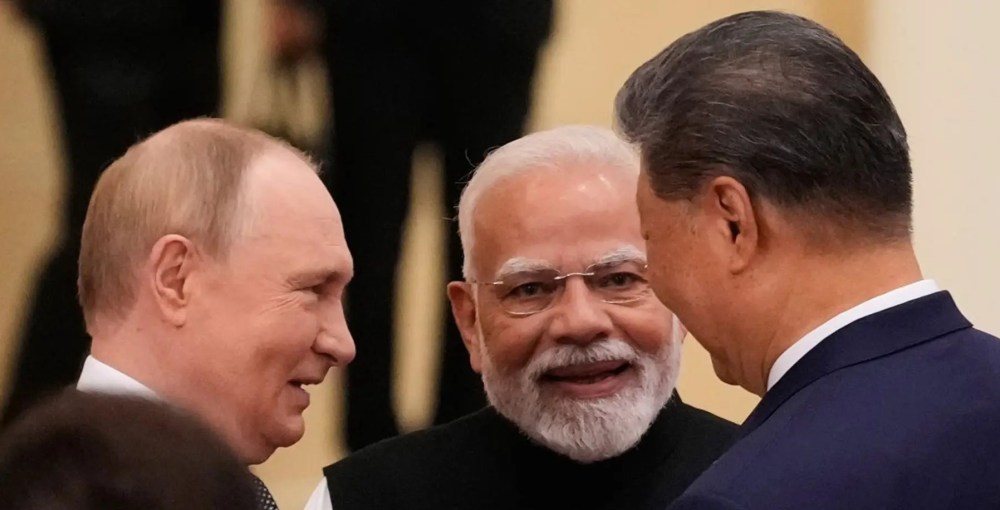
This week’s meetings and parades in China with a large gathering of what, in the previous Cold War lexicon, used to be called “non-aligned leaders”, focusing on the handshakes of the leaders of China, India and Russia, has sent a chilling signal to the West. With the United States focusing inward with the erratic rule of an imperialistic sociopath, and the European leadership vacuum, the developing countries in Africa and South-East Asia are attracted to the regulatory indifference of the new BRICS-driven market opportunities.
Donald Trump did not only destroy American influence on the global political and economic stage, he has set fire to that stage. In the chaos of his destruction, and the weakness in Brussels, Trump has created opportunities for the West’s adversaries to fill the void.
In a post-Regulatory Cold War, how should developing and non-aligned countries react? Would businesses in Brazil or Indonesia really need to care about EU demands for ESG or arbitrary US tariffs if the rest of the world has moved on and is rich in opportunity? Do emerging market governments need to bow to European leaders if their demands are too stringent or irrational? Will the UN organizations, with their useless plethora of endless conferences, negotiations and forums, become even more irrelevant?
Once the dust has cleared, the Regulatory Cold War was proven to be as empty as the military Cold War that had come before.
Acknowledgement: The idea for this article germinated from an interesting discussion I had earlier this week with two old friends in a Singapore café. Thank you for letting me build on this and feed off of your experiences.
________
Enjoyed this read (free with no ads)? Support The Risk-Monger via Patreon. Become a Gold-Monger patron for 5 € / $ per month and get David’s newsletter.


This seems a mis-reading of what Trump is trying to do. First, reducing regulations. The goal is to re-balance the risk-regulation equation: greater risk tolerance to free up capital and allow entrepreneurs to “entrepreneur.” Second, tariffs. Again, a re-balancing of trade barriers. Third, carbon reduction – why in the world should the US tie itself to the virtue-signalling of Kyoto/Paris/Copenhagen that ultimately harms the economically disadvantaged the most? Cutting USAID programs – well, none of us are sure what has truly been cut and what has been ported to other offices in the State Department or other Departments. What we do know is that USAID had wasted money on a great deal of woke corruption and its leadership refused to even account for where the money actually went.
His ultimate goals in this arena are primarily economic – as you say, it’s really not America’s job to mess with other countries’ internal affairs, either political or cultural. He recognizes the US’s unsustainable debt and is trying to deal with that. You and I can argue with the effectiveness of each action, but – like Bastiaat’s wise economist – I’ll wait for the long-term effects to be better understood.
One other thing to keep track of. Whether you or I like Trump or not, he is clearly trying to damp down the flames of war, with some success. No one else is making the same effort, nor achieving the same success.
LikeLike
History will interpret Trump in an interesting way and I don’t disagree with you on most points. My focus (from my perch in Manila after a conversation with policy actors in Singapore) was not about what Trump was doing inside the US or for American audiences, but how it affects policymaking in developing countries (especially as a contrast to EU meddling).
LikeLike
Thanks for the reply! One more re Trump: so much has happened since he took office that we sometimes forget that it’s been less than one year. It may take his full term (and then some) before we can truly gauge his impact. But I think it is clear that he is the most consequential US President so far this Century. The decade between 2018 and 2028 likely will be seen as a tipping point for the US and the world. We just can’t see far enough now to know what we all will tip into!
LikeLike
History will have an interesting time sorting this one out. Trump’s polarization is not unique (although the media tools have made it the most explosive). In Ronald Reagan’s first years, America was split and the rest of the world hated him, thought he was an idiot and feared for the future of the world. Books were published citing all of the stupid things he had said and done (no Internet in 1980). History seems to have cleaned up those messy years.
LikeLike