Part 3 of IARC’s Talc Journey
This is the Conclusion of a three-part series on IARC’s talc journey. The introduction examined how and why the three monographs differ. Part Two looked at dissenting voices in the third talc monograph and how the agency managed the issues panel members had. This third part will question the motives behind the methodology shift and ask if IARC has become more political than scientific and more intertwined with the interests of the US litigation industry. It will defend the following claims:
- The third IARC monograph on talc was nominated and conducted for the US litigation industry (via a number of IARC/Ramazzini scientists employed as litigation consultants).
- Many of the seemingly irrational or improper decisions by IARC on this third talc monograph can only make sense when seen through this litigation lens.
- The Ten Key Characteristics of Carcinogens was designed and promoted by a group of IARC/Ramazzini scientists working as litigation consultants with the intention of delivering more IARC “probably carcinogenic” (Group 2A) classifications that could be more simply presented to courtroom juries.
Irrational or Mal-Intended?
There are serious problems with how IARC conducted the third talc monograph published in 2025. If they did not follow the IARC procedures or scientific protocols, it should be asked whether there were other undisclosed motivations.
- The 2019 IARC Advisory Committee considered talc as a priority substance for the upcoming monograph meetings. Among thousands of potential substances that had not yet been considered by the monograph programme, and given there were no significant studies since the last talc monograph, was there really any justification for bumping talc again up the priority list?
- Why did the IARC expert panel accept the National Toxicology Program animal study in the third talc monograph, despite significant dissent from working group members (see Part 2 of this exposé) when the second monograph considered it irrelevant and inadequate?
- IARC rushed the publication of the talc part of the IARC expert meetings to June, 2025 instead of waiting and publishing the full monograph together in September of that year, together with the chapter on acrylonitrile. There was no reason to break with standard publication protocol and publish a partial document only to republish it in full three months later.
These were not rational or standard procedures, especially for an international research organisation attempting to project authority and rebuild their trust in the scientific world. IARC lost an enormous amount of respect with its political, unscientific conduct during and following their publication of Monograph 112 on glyphosate. At that time, there was a war of words between IARC and national risk assessment agencies as well as the European Food Safety Authority (EFSA), other WHO agencies and the media.
What could have changed between the second IARC talc monograph in 2010 and the third one in 2025 to have justified their actions. In between those years, the US litigation industry had filed tens of thousands of lawsuits against talcum powder producers and miners, but they were lacking a scientific agency report that the tort lawyers could use as evidence to convince juries that certain cancers were caused by exposure to talc (without the claim of asbestos contamination). Glyphosate (from 2015 to 2020) set a new playbook for activist science – to use IARC to produce a document that could be used in courtrooms as evidence for an endless stream of lawsuits linking a substance to a targeted number cancers. IARC more recently attempted to advance this playbook with monographs on aspartame and gasoline.
The third part of this series will highlight the role IARC’s third monograph has played in the litigation industry’s talc lawsuit strategy.
A Short History of Talc Litigation
- As of January, 2026, there have been more than 58,000 mass tort lawsuits filed against Johnson & Johnson (J&J) linking cancers to their talcum powder brands. There have also been many suits filed against talc miners and other brands although a common Predatort strategy is to target a single, large company and extort a global settlement.
- The first lawsuits were filed alleging ovarian cancer from long-term use of talcum powder in 2009. In 2013, the first major trial against J&J that favoured the plaintiff set a precedent for many more lawsuits to follow.
- As it was difficult to prove the link between ovarian cancer and talc without any strong scientific evidence, the litigation industry shifted its focus onto the possibility that the talc was contaminated with asbestos during the mining process.
- Between 2016-2018, numerous jury trials found J&J liable for hiding information about asbestos in their products, resulting in billions of dollars in damage awards for their talcum powder being the primary cause of mesothelioma and ovarian cancer.
- A 2018 Reuters investigation uncovered internal reports suggesting that J&J was aware of asbestos contamination in its talc. Reuters twisted the cautious scientific vocabulary and J&J, to this day, denies their talc products contain asbestos.
- In 2020, J&J announced it would stop selling talc-based baby powder in North America.
- Multiple settlement attempts and plans to fold J&J’s talc interests into a company that would then declare bankruptcy have failed.
- By the end of 2024, J&J had settled nearly all outstanding mesothelioma cases, leaving the lawsuits linking other non-asbestos related cancers to talcum powder. Until the third IARC monograph, these cases lacked sufficient scientific evidence that could be presented to juries.
This timeline relied on sources here and here.
IARC’s Army of Litigation Consultants
These thousands of lawsuits, on their own, should not be of any importance to an international agency whose mandate is to determine and prevent carcinogenic hazards. But the individuals who are part of the core IARC community have become quite closely intertwined with the IARC hierarchy and administration, either directly or via the Collegium Ramazzini network (a private network of scientists active in trying to link cancers to chemical exposures).
SlimeGate is not only an investigation into the motives and practices of the Predatort law firms but also the entire litigation industry ecosystem from litigation finance firms to ad agencies to plaintiff processors in the misery merchants trading cases in the so-called victim exchange. This complex is closely involved with media groups, foundations, activist NGOs and scientists who serve as litigation consultants. The Predatort Playbook relied heavily on activist scientists being able to deliver research evidence that could convincingly be presented to juries (often by these same scientists).
The Collegium Ramazzini, with its close ties to IARC monograph working groups, often provide a large number of litigation consultants and expert witnesses (who could use their position on IARC monograph expert panels to justify their expertise. As they would usually earn anything starting from $500 per hour to testify or prepare documents, this was a highly desired side occupation.
These scientists have not only profited personally from their consulting work for US tort lawyers, they have also used IARC to push their agenda. Recall the SlimeGate story of how several IARC / Ramazzini scientists working for US tort law firms demanded that IARC do a further monograph on benzene because their previous monograph had failed to link benzene to non-Hodgkin lymphoma (for which their law firm employers had many potential lawsuits pending). And IARC complied with their demand.
The political spirit purveying through the Collegium Ramazzini culture is that most cancers are caused by exposures to synthetic chemicals and that the companies producing these chemicals must be held liable. The concept of “adversarial regulation” was developed by several IARC / Ramazzini scientists like Bernard Goldstein who believed that the most effective way to enforce change on corporate behaviour is to threaten to sue them out of existence if they do not abandon their practices. Goldstein relied on IARC to produce the evidence his law firms needed. See his exchange with IARC’s head of monographs, Kurt Straif:
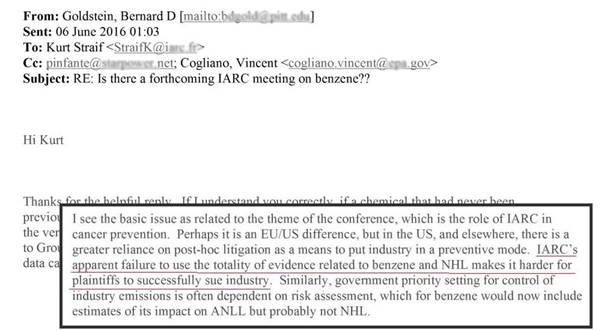
Given what Goldstein did to push IARC to do a further monograph on benzene on behalf or his employers in the US litigation industry, and what seems to have also occurred when Chris Portier got glyphosate added to a monograph originally scheduled on insecticides, it does not stretch the imagination to conclude that litigation consultants working on talc lawsuits would likely then have persuaded IARC to deliver the needed Group 2A carcinogenic classification for talc without asbestiform contamination.
These Collegium Ramazzini fellows were not passive partners in the litigation industry strategy. They were fully engaged with their own objectives. IARC monographs are core to their strategy (SlimeGate has demonstrated this with their monographs on glyphosate, benzene, aspartame, gasoline and now talc). But they needed a tool to determine carcinogenicity that could also be clear enough and simple enough to present in front of a jury. A group of Ramazzini/IARC scientists, many of whom are long-time litigation consultants, developed the Ten Key Characteristics of carcinogens for this purpose.
We need to take a closer look at the scientists behind the Ten Key Characteristics of carcinogens strategy and how IARC was quick to adopt it in its 2019 Preamble update (the monograph guidance document).
The Ten Key Characteristics of Carcinogens
The concept that there are ten key characteristics that carcinogens share was introduced in a paper published in 2016. It starts with a challenge:
“This (monograph) exercise was complicated by the absence of a broadly accepted, systematic method for evaluating mechanistic data to support conclusions regarding human hazard from exposure to carcinogens. … These characteristics provide the basis for an objective approach to identifying and organizing results from pertinent mechanistic studies.”
The Ten Key Characteristics of carcinogens was, in part, a means to dispute a persuasive paper published in Science the year before by Cristian Tomasetti and Bert Vogelstein of Johns Hopkins University. They argued that two thirds of all cancers are due to bad luck (random mutations). This paper caused such heated discussions that IARC actually issued a press release to try to debunk the position.
The IARC / Ramazzini scientists needed to show that there was a systematic and objective method to prove that most cancers are caused by environmental exposures (and not random mutations). It would be hard for a lawyer to determine the cause of a plaintiff’s cancer if most cancers were simply bad luck. The Ten Key Characteristics was IARC’s response.
The concept claims that cancers share many of the same characteristics. If a substance, for example, is genotoxic, alters DNA, induces oxidative stress or chronic inflammation … then there is a certain likelihood it is a carcinogen. The logic is that the more of these characteristics a substance shares, the more carcinogenic it is. If benzene, for example, shares seven of the ten key characteristics, there is strong confidence that it is carcinogenic. Recall that IARC merely conducts hazard assessments, so a finding like “glyphosate is genotoxic” does not consider at what dose or level of exposure such a hazard might become an actual risk.
The problem with this checklist approach is that any substance can fall under a certain number of these characteristics and still not be carcinogenic. A paper published by Becker et al found the 10 Key Characteristics to be so open as to not be able to competently discriminate between a carcinogen and a non-carcinogen. Becker tested the Ten Key Characteristics against 248 substances (of which 54 were carcinogens) and found the IARC checklist could not distinguish the non-carcinogens.
Everything gives you cancer … or maybe it does just come down to bad luck.
Speaking personally, I suffer from hip and neck osteoarthritis and fight chronic inflammation which can cause extreme pain during flares (why so many oxycontin and fentanyl addicts are in their senior years). This does not mean that I have cancer nor will my arthritis increase my risk of cancer. But chronic inflammation seemed to have been enough for the third IARC monograph to determine that talc was probably carcinogenic. Part 2 of this exposé noted how Andrew Ghio argued that IARCs conclusion of a second key characteristic, “altering cell proliferation”, can be caused by chronic inflammation. By the way, aubergines, peppers, tomatoes and jogging also cause inflammation (but they are natural and not produced by industry so IARC does not seem to be interested).
It is hard to imagine how responsible scientists would have the audacity to concoct such a manipulative scheme as the Ten Key Characteristics of carcinogens, unless they had ulterior motives. And it is inconceivable that an international research agency, lightly aligned with the WHO, would acquiesce in such a campaign. After losing so much trust in the research community in the 2010s with their controversial political activism surrounding glyphosate, red meat and coffee, IARC civil servants still seem impervious to criticism and scientific scrutiny.
The Architects of the Ten Key Characteristics
Many of the scientists involved in the Key Characteristics research, workshop and paper are tied to the Collegium Ramazzini, have lobbied government regulators and have worked as serial litigation consultants having earned tens of millions of dollars testifying and preparing briefs on behalf of plaintiffs in lawsuits. At least ten of the 19 scientists involved in the IARC 2012 workshop to establish the Ten Key Characteristics have these ties. They knew what the value of a stronger, more objective means to determine carcinogenicity would be for lawyers trying to convince a jury they have valid evidence.
The lead author of the Key Characteristics publication, Martyn T Smith, has earned millions of dollars testifying as a litigation consultant in a countless number of lawsuits. The money was so good that Smith set up an NGO front group called CERT (Council for Education and Research on Toxics), that was located inside of a tort law firm, Metzger Law Group, with the objective of providing evidence for lawsuits and for enforcing California’s Proposition 65 pronouncements. Smith knew exactly why the Ten Key Characteristics of carcinogens was needed.
Another important author on the Key Characteristics paper was Christopher Portier. His role within IARC, in securing a monograph on glyphosate and then promoting the IARC “probably carcinogenic” classification through different regulatory agencies around the world, was an affront to scientific integrity. Portier was campaigning against glyphosate, publishing further papers and attacking IARC’s critics while secretly earning hundreds of thousands of dollars from lucrative contracts with the US litigation industry that were filing thousands of glyphosate lawsuits against Monsanto. It comes as no surprise that in this 2016 Key Characteristics publication, Portier decided not to declare the conflict of interests from his work then for US tort law firms. At least Martyn T Smith had the decency to admit to the payments he had received from these special interest groups.
Retraction Roulette
I don’t see anyone demanding the retraction of the main Key Characteristics paper (as done with the Williams et al paper suspected of having had support from Monsanto) because Portier lied about his funding and special interests. Although it seems rather rich that Martin van den Berg, editor of the Journal of Regulatory Toxicology and Pharmacology (that retracted the Williams et al paper), also participated in a Key Characteristics of Carcinogens workshop. What hypocrites.
Even more hypocritical, the Lancet recently retracted a paper on talc from 1977 because the anonymous author was claimed to have consulted for J&J. In the 1970s, this was not unusual. The retraction was based on a report by two academics who have consulted for law firms suing J&J. As the Predatorts are more frequently coming out from the shadows, it is becoming clear who is actually pulling the strings in the IARC/Ramazzini Complex.
The workshops and working groups on the Ten Key Characteristics of carcinogens were organized by IARC, with Kurt Straif (then head of the IARC monograph programme) and Kathryn Guyton (lead author of IARC’s glyphosate monograph), also listed as authors in the 2016 concept paper. Their goal was to integrate the Ten Key Characteristics into the 2019 update of IARC’s Preamble (the guidance document for how carcinogens can be evaluated and classified).
As seen in Part 1 of this talc exposé, in 2019, the same year as the update of IARC’s Preamble, their Advisory Board met to nominate future candidate monograph substances, including a third monograph on talc (which, without any good reason, was given a high priority).
Of all of the experts on the IARC Advisory Board panel, only one had ever researched or published on talc issues, and that was Fiorella Belpoggi, the then head of the Ramazzini Institute (which has long campaigned against talc). Given that the head of the IARC monograph programme, Kurt Straif, has been deeply involved with Ramazzini, it would seem that these two participants decided themselves that talc should once again be included in the candidate list for an upcoming IARC monograph. This decision was pure politics given that there were no significant studies that would have justified such a decision.
No wonder government risk assessment agencies do not pay much heed to IARC’s pronouncements and political activism.
At the same time, in 2019, there was an avalanche of new lawsuits being filed claiming different cancers being caused by exposure to talcum powder products. This was concurrent with tens of thousands of glyphosate lawsuits being filed every month relying for evidence solely on the hazard-based IARC classification that, until today, not a single government risk assessment agency has agreed with. IARC and glyphosate working group scientists were actively involved in these cases, either by attacking scientists who disagreed, lobbying regulators or by serving as expert witnesses testifying on behalf of the plaintiffs.
The IARC/Ramazzini Culture
It was mentioned earlier that at least ten of the 19 scientists involved in the Ten Key Characteristics strategy were Ramazzini / IARC scientists who saw such political activism as integral to their scientific work.The boundaries between science and activism are blurred in the Collegium Ramazzini’s bylaws.
“Taken as a whole, the purpose is to be that of a bridge between the world of scientific discovery and those social and political centers which must act on these discoveries to conserve life and prevent disease.”
Back to the Ramazzini / IARC concept of adversarial regulation, this group of activist scientists, perhaps scarred by the years of Big Tobacco lobbying during their careers as regulatory scientists, rightly or wrongly feel that government regulators are captured by industry. For them, a better (and more lucrative) alternative is to work directly with the US litigation industry. This unholy alliance was cemented well before the third IARC talc monograph, and IARC did little to disguise this interest.
The Litigation Lens
The irrational decisions made during IARC’s third talc monograph can only make sense if we change the perspective. IARC should not be considered as a global cancer agency seeking to discover the causes and finding the means of preventing cancers, but rather as a collection of activist scientists, closely tied to the private Collegium Ramazzini, with the goal of using scientific research to prove links between cancers and chemicals produced by industry (while serving the interests of the US litigation industry).
Some examples of how our lens on this agency should be refocused:
- The Ten Key Characteristics of carcinogenicity added an extra factor to classify a substance as “probably carcinogenic” – Group 2A. The “possibly carcinogenic” decision (group 2B) from IARC’s second talc monograph in 2010 would not be sufficient to persuade a jury in any talc lawsuits.
- These Key Characteristics add a perception of objectivity when cited in court during expert testimonies. If a scientist were merely to say that talc causes inflammation, and this could cause cancer, most people would not be outraged. But to round off of list of scientific or medical terms and saying they are all characteristics of cancer can be very persuasive.
- The decision to accept the National Toxicology Program animal study as evidence in the 2025 monograph, despite it being considered inadequate and irrelevant in the 2010 monograph, was tied to a decision in the 2019 IARC Preamble update to lower the standards for accepting animal study evidence.
- The decision of IARC’s Advisory Board to nominate talc as a candidate substance for a further monograph despite there being no significant new research publications was due to the ongoing litigation cases in the US, especially those filed where cancers not tied to asbestos contamination otherwise lacked sufficient scientific evidence. Many scientists within the Ramazzini / IARC circle were moonlighting as litigation consultants on talc lawsuits, but the quality of the evidence was paltry.
- IARC rushed the publication of the talc part of the IARC monograph to June, 2025 instead of waiting until September of that year when the other chapter on acrylonitrile was ready. The only justifiable reason to break with standard publication protocol and publish a partial document was to ensure that tort lawyers could use the agency’s monograph as soon as possible in ongoing talc lawsuits.
The rationality of these decisions might be justifiable with the context of IARC being at the service of the US litigation industry via their zealous Collegium Ramazzini scientists working with these law firms, but it certainly is not ethical, scientific or in any way promoting research integrity.
Following the abuse of the third talc monograph within the context of the ongoing US litigations, it must be concluded, again, that IARC’s monograph programme is not fit for purpose. IARC should not be considered as a scientific body, but rather as a political organization that allows their panel members and Ramazzini confreres to profit nicely as litigation consultants while advancing their activist ideology.
Since 2018, SlimeGate has been one of the few documents, a living research text, trying to expose the corruption and lies behind the litigation industry. If you enjoyed this read (free with no ads) or the entire SlimeGate exposé, why not support The Risk-Monger via Patreon? Become a Gold-Monger patron from 5 € / $ per month and get David’s newsletter.
 The Risk-Monger