To put it lightly, the tobacco industry is unloved. The WHO has led a decades-long campaign to denormalise “Big Tobacco” – ostracising these companies and working with activist allies to exclude them from participating in policy, public discourse and societal institutions. There are an army of institutions and NGOs who have one goal and only one: destroy the trust and market for tobacco and nicotine products. No public actors, literally no one, will stand up and defend the tobacco industry’s right to exist.
And yet, still, they do exist.
Like it or not, tobacco products and the companies who sell them (as well as the value chain from the farmers to the retailers) are legal in all countries. And as they contribute an enormous amount into the public till via taxes and employment, they should enjoy the same rights as other industries and be treated as any other stakeholder representing a considerably large consumer group. Anything less would be pure hypocrisy.
But in a world dominated by righteous actors imposing their moral dogma on the policy process, denormalising Big Tobacco is de facto (as is the institutionalised hypocrisy against this industry). It is a moral imperative for enlightened leaders to condemn the tobacco industry, heavily regulate their products and protect vulnerable populations.
If you work for this industry, your key issue is not financial risks, it is not health risks, nor is it market risks. Your challenge is to manage righteous risks: your moral right to continue your business, participate as a legitimate stakeholder and speak for your consumers, your value chain and your market. But you are facing enormous headwinds: heavily-funded NGOs, morally-driven foundations, self-assuming public health groups, righteous regulators and media opportunists. It can be pretty lonely as the societal narrative has determined that your industry is persona non grata.
And yet, still, you do exist.
Like any industry facing any risk, the solution is to innovate. In the case of the tobacco value chain, innovation is essential for survival. Big Tobacco has, to a large extent, forsaken tobacco in Western markets, often openly acknowledging the health risks from smoking. They have introduced innovative alternative products in line with a harm reduction strategy: heated tobacco, e-cigarettes, nicotine pouches… and in doing so, have removed the main health hazards of smoking tobacco products. In a public health world, within the scientific community, within their consumer groups, these innovations are recognised and appreciated; in a righteous risk world, their new products are seen as old wine in new bottles. Activists, health advocates and righteous regulators are scrambling to keep that hated industry in its box, limit any innovative developments and keep the outrage narrative front and centre.
But the reality is clear: these alternative products are safer, saving lives and improving public health as smokers switch over. If you are a righteous regulator, activist or health advocate, these facts don’t matter in the face of moral certitude. In a world driven by emotional outrage, facts can be changed with the appropriately calibrated research methodology. Such is the challenge of how to manage the righteous risks confronting tobacco alternatives.
About Righteous Risks
In the Introduction to this series, a righteous risk was defined as:
“… a threat of harm to societal well-being that arises when decisions are based solely on widely-shared moral perceptions, social virtues and ethical ideals. This value-based policy approach does not consider facts or data in a consistent manner with certain actors, reinforced by social media tribes, imposing their ideals upon others. Righteous zealots (particularly environmental activists, naturopaths and food puritans) are more intensively forcing their moral dogma upon the policy process.”
For tobacco companies, the risks to the right to market for nicotine alternative products are not health and safety risks nor are they production or operational risks, but rather righteous risks, pure and simple. Can these companies jump through enough hoops and do what it takes to earn the moral approval of a band of health zealots, most of whom have spent much of the last 50 years of their lives hating them? Their safety data, consumer studies and regulatory compliance results don’t matter in this process. Righteous risk management is clearly the hardest form of risk management as its value-based obstacles rest upon pure emotion.
What follows are a series of cases where the tobacco industry suffered from the hypocrisy of regulatory righteousness in the European Commission. It will focus on e-cigarettes (vaping products) but the bent governance processes are also clearly evident in how snus and nicotine pouches have been mismanaged on moral grounds.
- In flouting the democratic policy process, the European Commission intimidated an independent think tank into kicking out the tobacco trade association, Tobacco Europe.
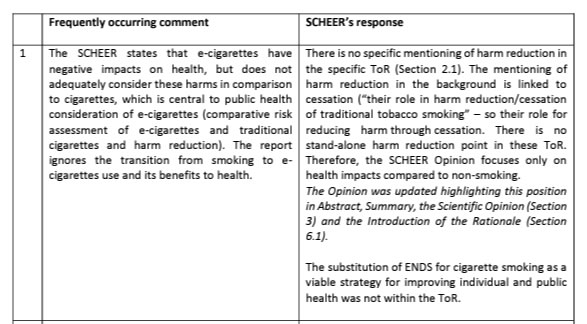
- In conducting a risk assessment on e-cigarettes, the European Commission explicitly did not ask the SCHEER to consider the comparative risk of vaping versus smoking tobacco products.
- In early 2022, the European Parliament requested a comparative assessment of the health risks of e-cigarettes and tobacco smoking. To this day, the European Commission has not complied.
- In a three-million-euro tender for a consulting contract on EU tobacco strategies, the European Commission did not ensure a competitive process and ignored the flagrant conflicts of interest of the health NGOs in the only accepted bid.
When regulators feel they have morality on their side, they do not have to follow proper regulatory procedures (and very few are speaking out). As most industries are being tobacconised, these recent righteous risk episodes should serve as a sober warning to other business leaders.
Denying the Freedom to Operate
It is one thing for businesses or NGOs to decide to exclude organisations or individuals they revile. But what about governments or institutions? Should public officials discriminate against companies operating legally purely on personal moral perceptions?
During the summer of 2023, the European Commission informed a Brussels-based think tank, the European Policy Centre (EPC), that if they did not terminate their relationship with Tobacco Europe, then they would be cut out of any European Commission support, cooperation or projects. See the exchanges on this affair and screenshot below. The EPC is a privately-run operation that relies on membership dues to operate. Tobacco Europe, as a trade association representing businesses that operate legally across the European Union, was a passive member of the EPC.
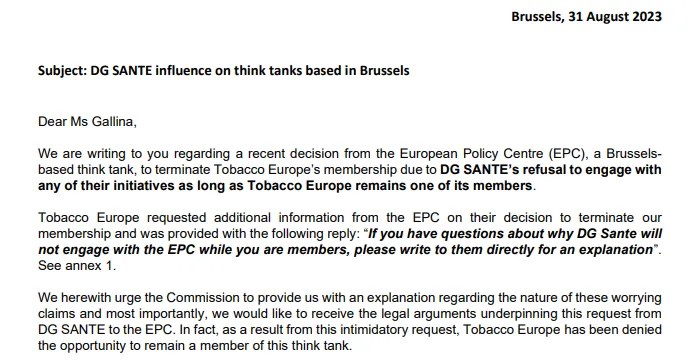
How did European Commission officials feel they had the right to intimidate a private think tank into excluding a large stakeholder group from the democratic policy dialogue process. The only justification for this decision was that a certain group of insulated bureaucrats ignored the democratic process to play the righteous card.
How should this righteous risk have been managed?
- The EPC should have stood up on principle and refuse to succumb to such rank intimidation.
… But for them, such a situation would have existential consequences. - All industry groups should have come together to publicly protest this egregious intimidation and violation of the rights of stakeholders to be represented in a democratic policy forum.
… But for them, as the second slowest zebra, they did not feel any need to take action.
Instead, the EPC just quietly refunded Tobacco Europe’s membership dues and closed the door behind them. A failure in righteous risk management.
Months after the fact, I was the first person to have reported on this scandal (in October, 2023 having discovered the story by accident). Six weeks later, Politico Europe ran a short segment based on, and quoting, my article (that they failed to reference … hacks) but other than that, it seems that most people were not alarmed by this denial of the right to engage in the policy process. No other industry group, not even Business Europe, stood up to defend one of their members.
So who is next? The righteous zealots in the European Commission will see little resistance to them going back to the EPC and demanding that they kick out all fossil fuel industry members because it is their moral duty to act to prevent climate change. How about chemical companies?
Calibrating your Research Advice
The answers you get depend on the questions you ask.
Righteous regulators seeking the moral high ground still need a semblance of evidence to justify their positions. In 2020, when the European Commission was updating their scientific information on e-cigarettes for the Tobacco Products Directive, they asked the SCHEER (Scientific Committee on Health, Environment and Emerging Risks) for the latest data on vaping. But they only asked the SCHEER to compare the safety of e-cigarettes to non-smoking. They did not ask to compare vaping risks to smoking tobacco products. It should come as no surprise then that the advice given to the European Commission was that the increased use of e-cigarettes could be a health concern (although still evaluated as a low to moderate risk). I can’t help but wonder how the perspective would have changed should they have acted on the advice that vaping considerably reduces potential harm compared to smoking. That is how people in the real world think when they need to find an effective way to quit tobacco and improve their personal health.
In response to precautionistas, I have argued far too often that there is no such thing as “safe” and that regulators should continually aim at “safer” – it took two years of traumatic lockdowns for our naïve Western risk managers to figure that one out. But if you require evidence to reinforce your moral imperatives, then you can trample on scientific methodology while staking your position as a civil guardian protecting your citizens from any hazard by invoking the precautionary principle on value-based issues.
The SCHEER, as a risk assessment committee, can only answer the questions it receives, no matter how rigged or inappropriate they may be. The main criticism levied during the public consultation following their risk assessment was that they did not consider the reduced harm effects of e-cigarettes compared to smoking. The SCHEER response, see image below, was that this was not in their remit (ToR) to consider such important regulatory evidence (ie, the European Commission did not ask the right question). In any case, who would ever consider demanding a rigorous regulatory science approach if it meant it would reveal data supporting Big Tobacco’s harm reduction strategy?
Well, it seems the European Parliament did. In February, 2022, a communication was issued demanding:
“… the Commission to follow up on the scientific evaluations of the health risks related to electronic cigarettes, heated tobacco products and novel tobacco products, including the assessment of the risks of using these products compared to consuming other tobacco products, and the establishment at European level of a list of substances contained in, and emitted by, these products; considers that electronic cigarettes could allow some smokers to progressively quit smoking; …”
Two years later, the European Commission has not made any attempt to reconsider their weak risk assessment. Perhaps these righteous regulators are afraid of the answers they would get should they ask the right questions.
The answers you get depend on whom you are asking
More and more European Commission activities are being outsourced to consulting firms and expert third parties. Since the days of Edith Cresson’s dentist, the guidance defining the process for awarding of contracts have become far more rigorous, with intense scrutiny and a series of checks and balances that, in the case of the EU Research Framework Programmes, have been criticised by scientists as being too cumbersome. Except … maybe … when the European Commission needed to select a consortium to advise it on their tobacco programme.
In February, 2023, the European Commission’s DG Santé launched a tender process for an external consulting contract to support the implementation and development of policy and legislation, review the existing tobacco control laws and lay the groundwork for new laws. The tender was for three million euros so there should have been widespread interest among stakeholders. Strangely there was only one tender and rather than reopening the process to ensure competition, the European Commission chose to award the funds to this consortium.
Even more disturbing is that certain members in the consortium that would receive the €3,000,000 to advise European officials, had glaring conflicts of interest. One group, the European Network for Smoking Prevention (ENSP), an activist NGO running a campaign to make Europe not just tobacco-free, but also nicotine-free by 2030. So what sort of advice would this anti-vaping group offer when consulted on the European Commission’s programme for a smoke-free Europe by 2040?
Another group in this consortium, Vital Strategies, is an anti-vaping advocacy group funded by Michael Bloomberg. Should the Commission be seeking advice from groups who receive their marching orders from American billionaire health activists? These zealots cannot accept a world where vaping continues to be permitted so it beggars belief that they have been awarded three million euros to advise the European Commission on its nicotine product policies.
When confronted by the potential conflicts of interest in a question in the European Parliament, the Commission replied that the members all signed documents (declarations on honour) declaring they would remain impartial and objective in their advice.
Really now… The European Commission should follow this up since the head of the ENSP later told Euractiv that, as an NGO, the very concept of a conflict of interest is not applicable. Thank goodness these organisations are all virtuous. Otherwise there might be a need for some scrutiny.
The European Commission feels enabled to ignore proper tender procedures and award a large contract to organisations they like, ignoring their conflicts of interest, because any action they would take would be against Big Tobacco. Who would possibly care, speak out or stand up and defend this industry? The media, terrified of being accused of supporting tobacco companies, has largely chosen to not do their job. And the NGO activists don’t even have to do their job but just dust off their old anti-smoking campaigns and change the word to “nicotine”.
The tobacco industry, in the past, may have broken rules and went around the system, but the European Commission is now doing exactly the same. They may feel they are doing it out of some sense of moral righteousness, but that does not hide the stench of their corruption. I suppose if no one is holding them to account, then DG Santé can just do what they want.
Institutionalised Hypocrisy and Righteous Risk Management
So how should these companies manage the exposure to righteous risks on e-cigarettes? The regulations restricting reduced-harm nicotine products coming out of Western governments is not scientific, rational or consistent but they are meeting certain ethical and emotional standards demanded by health stakeholders with ulterior motives.
The best industry can do here is group together to demand a just regulatory process. Cigarettes and other nicotine devices are still legal in all countries and thus demands regulations meeting the best available science and policy approaches. Industry stakeholders need to fight to ensure that the regulatory process, the democratic process and the scientific evidence is respected. Why haven’t they?
What we are seeing here, as is common in many righteous risk cases, is pure hypocrisy by everyone involved.
- Activists and health zealots are producing bogus research and cherry picking data to create an impression that e-cigarettes are not safer than smoking, creating public confusion and promoting continued use of tobacco products.
- Civil servants are obsessing on the health risks of vaping and the need for regulatory restrictions while overlooking more serious emerging health risks, like synthetic cannabinoid use, that many health activist groups are promoting.
- Governments are aggressively working to isolate the tobacco industry from the democratic regulatory process in the most hypocritical two-step in the history of governance, essentially saying: “We hate you, go away … but we need your tax revenues.” There is a certain word to explain someone who takes money from an actor he or she reviles, and lies down to take the money again and again (but this is a family website present on many university reading lists).
- Industry groups, and this is the saddest part of this pathetic story, have chosen to look away and not defend members of their community. Not one business group has spoken out against these egregious regulatory violations. Like second slowest zebras, they continue business as usual, assuming they won’t be next in what has clearly become a tobacconisation strategy against all industries. But the stench of their cowardice is far more pungent.
If we allow such righteous risks to continue unabated, then we have to accept this for what it is: institutionalised hypocrisy. Like any hypocrite, they have little concern for the negative consequences from the pursuit of their disgraceful agenda. People will be confused on the safety of alternative nicotine products. Many will stay with or go back to smoking. More people will die prematurely due to these righteous health zealots.
________________
Enjoyed this read (free with no ads)? Support The Risk-Monger via Patreon.
Become a Gold-Monger patron for 5 € / $ per month and get David’s newsletter.
 The Risk-Monger
Righteous risks, not susceptible to reason and facts. Australian prohibitionist “initiatives” in a futile effort to control “vapes” are a textbook example confirming the accuracy of your assessment, long on assertions of harm and short on evidence. The official hostility to “vapes” is doubtless because they are an untaxed market substitute for astronomically taxed tobacco, and looks like smoking, offending vested interest neo puritans.
LikeLiked by 1 person