French translation
The final nails in the coffin of scientific expertise seem to have been brutally hammered in during the summer of 2024.
How bad has the abuse of scientific expertise become that people have been celebrating last month’s Supreme Court’s overturning of a Reagan-era decision known as the Chevron Deference. The original ruling essentially stated: “When in doubt, trust the experts”. Conservatives cheered that decision then. More than 40 years later, the same court has now decided that experts are not to be trusted (and conservatives are again cheering).
Whiskey, Tango, Foxtrot!!!
Those on the other side of the Great American Divide are blaming a US Supreme Court gone rogue, but I am inclined to think that the behaviour of certain arrogant scientists has not helped the cause of evidence-based decision-making. Regardless of political polarisation, the demands to: Listen to “the” science! or: “Trust” the experts! has started to ring very hollow among the chattering classes.
What is coming out of public discourse today is a hostile reaction against expert advice. If the FDA says “Don’t drink raw milk”, then social media is full of influencers convincing pregnant women that drinking raw milk is the best thing for their foetus (No, I am not making this up). Every time a Department of Agriculture spokesperson reassures the public on the safety of pesticides or GM technologies, the organic food market share spikes. The CDC would be better advised not to communicate on vaccine safety at all than continue to claim all vaccines are 100% safe.
How did we get so jaded?
Arrogantists
People react to risk issues emotionally and if they see a public servant in a white coat arrogantly speaking over the heads of the public:
- about how leaders in their community are wrong;
- about how they have to accept certain decisions as fact;
- about how they would have to make sacrifices to their lifestyle because what they say is the truth;
- about how what they are afraid of, or what they fear for their children, are considered nonsense and they would have to suck it up;
… then it is not surprising that people are reacting against these experts. They come across as arrogant – a perception that blinds and deafens how their facts are received and then perceived. Perception is everything as that is what trust is built on. People go to the Internet and try to figure stuff out themselves when they do not trust the person telling them what to believe or do.
Regulatory scientists have an image problem. They are seen as arrogantists: people who think and act above the rest of the population and expect everyone else to bow to their expertise. And by “their expertise”, they mean what those within their academic circle think and have declared as the consensus (not what other so-called experts might argue).
It is not that people are choosing to believe stupid things because of a lack of intelligence, but rather that they are choosing to be excessively suspicious of advice from arrogantists and their institutions which they neither trust nor respect. Trust is emotional, relational and personal and in today’s social media driven world, we trust people like us, from our tribe and our communities (see my Blockchain Trust series).
Science is built on a methodology of hypotheses being strengthened by resisting falsification – an integral humility that hypotheses may be wrong and a willingness to self-correct. Too often, with open and evolving risk issues (from pandemics to chemical exposures to interest rate policies), scientists are acting from a position of infallibility. “Bow to the expert” they tell us. But when arrogantists are wrong, there is then no forgiveness or tolerance.
In periods of uncertainty, distrust more commonly influences our decisions than evidence. NGOs, activists and special-interest-driven influencers know this and excel at spreading fear and doubt of the capacity or intentions of our institutions, experts and industries. We no longer trust expert advice, seeking guidance rather from those like us or trying to find things out for ourselves (according to our algorithms). Our common sense is more trusted than expert advice from some faceless bureaucrat.
I’m right and you’re stupid
In the 1990s, I was one of the early actors in the emerging field of science communications (as certain risk issues started to become loud and politically intransigent). We believed then, naïvely, that a clear communications of scientific information would reassure publics, restore trust and add rationality to policy debates. But by the second generation of sci-com, as algorithms started to sort science communicators into different tribes (left v right, engineers v toxicologists, epidemiologists v virologists …), they started hating each other. Things worsened.
Much of what we had attempted to develop with scientists in the 1990s (dialogue, engagement, transparency…) went to pot when a well-managed Swedish teenager came to town on a boat and started growling at people. I started to notice an inherent arrogance (I’m right and you’re stupid) within the science communications communities and this has done anything but improve public trust in research and technology.
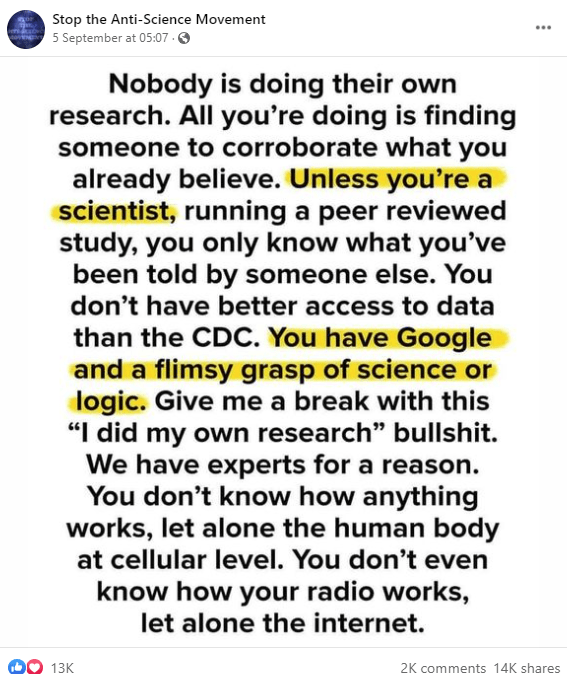
I read a rather regrettable post from a science communications page with a fairly large following. It encapsulated everything wrong with where sci-com is going – arrogant, intolerant, superficial and naïve towards what the public needs when considering buying in to some innovative technology. This group basically detonated a trust-bomb on a vulnerable population, forcing them to seek refuge from whichever guru or activist group could deliver the right dose of empathy and reassurance. In brief, I screamed out loud when reading this meme – every sentence was not only wrong, it’s approach was intended to alienate and insult. Wither any hope for trust in science.
Fauchood
Following Karl Popper, scientific theories are built on conjectures that best withstand falsification attempts. So scientists by nature should be sceptical (and humble). These conjectures may be limited by available data, present paradigm assumptions, existing analytical technologies or cultural bias. Climate science claiming that the present warming is caused by greenhouse gas emissions from fossil fuels is one such conjecture that has been tested with some limited success on the models and forecasts drawn up. But that limited success then became a claim to truth and politics took over – the science was shut down.
But when scientists move from conjecture to a contrived consensus to claiming the truth, this is politics. The arrogantists who attack any reasonable (and necessary) scepticism of their conjectures are doing a disservice to science by interfering with the method and inserting political or personal interests, bias and beliefs. Significant errors have been based on far less than this, but if arrogantists believe they are infallible, it may take decades for these errors to be fully accepted by a politically-imbued scientific community … if ever.
Rather than listening to contrary views that should help make the process more robust, scientists have been seen making ad hominem attacks, withholding data, directing research away from weak arguments and promoting (their) consensus onto the public narrative. Not everybody is that stupid though as to follow them down that rabbit hole of their ego, and their dissent distracts and creates distrust, not in the scientific conjectures, but in the reliability of science itself.
Science and scientists are front and centre in a social media-driven political landscape. With COVID-19, the public were understandably concerned about the uncertainties of an unknown respiratory virus and the political leaders, fearing electoral consequences, hid behind their scientific experts. Every day, in each country, a designated scientific advisor (often, tragically, a virologist) was singing from the “what we have learnt so far” song sheet, next to a “death-count” monitor on the right of their TV screen, while what the public wanted was certainty, reassurance and no more death counts.
But what the research community had, in the first year of the pandemic, were a lot of conjectures that had not had the time to build robustness from being tested and challenged. Masking or not, hard lockdowns or not, intubation or not … everyone was learning and self-correcting (in full public view). The scientific expert had to present the most recent conjecture with the authority and confidence the political environment required. Anthony Fauci was able to speak with an authority of his position, but without the knowledge of the scientific community given the ongoing (normal) scientific process of testing hypotheses. His statements came across as arrogance and when science self-corrected, trust in his authority was lost (or at best divided along political lines). One conjecture debate, post-pandemic, on the origin of the virus, has created a heated discussion, with the hard-core arrogantists refusing to listen and rallying their consensus-mongers to label the lab-leak postulators as lunatics. To protect their consensus view, no discussion should be tolerated.
Consensus-Mongers
Whether it is religious zealots in the 16th century or arrogant scientists in the 21st century, there has always been a great deal of intolerance for anyone who dares to challenge the consensus.
Scientists who do their job and question scientific conjectures are shell-shocked by relentless bullying from the consensus-mongers. When I signed the Great Barrington Declaration, I was accused of being a COVID-19 denier. When I recently shared a horrible experience after my second COVID-19 vaccine, I had to put a picture of me being vaccinated to keep off the vaccine vigilantes. After questioning whether renewables was the best way forward to reduce CO2 emissions (not to mention the unethical lobbying practices of this sector), I was charged with being a climate change denier. The German government accused the European Commission of greenwashing when they declared natural gas and nuclear energy to be sustainable sources of energy.
Consensus-mongers fall under what could be called “groupthink”. The disturbingly sexy (in a rather German way) science communicator, Sabine Hossenfelder, unleashed a surprising attack on the arrogance of climate science groupthink in a recent post:
“….the community of climate scientists is trying to enforce a narrative that they want their members to play along with. … That a group develops and enforces a narrative that they require loyal members to conform to is one of the most obvious symptoms of groupthink, and the climate change community is very deep into this. It’s bad for one thing because it discourages criticism and increases the risk of mistakes. It’s also bad because people who are not in the group, like Dr. Soon and me, notice it which creates a backlash. … So here’s Sabine to climate scientists: Stop censoring your own people.”
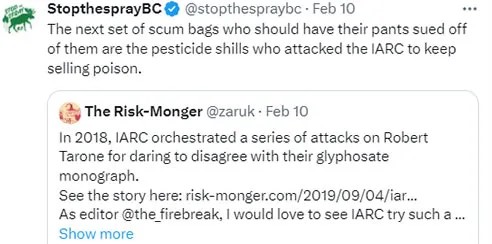
Arrogantists who work harder to censor their opponents than to make their theories more robust are not, in any sense, being scientific. Hurling insults rather than data, excluding adversaries from panels and trying to undermine careers or research funding … no wonder experts are losing trust. Worse, when arrogantists like Michael Mann take their opponents to court on political grounds, the scientific process is mortally wounded.
Should I now be careful about challenging a scientific hypotheses because I might be taken to court?
Science: A Pagan Cult ???
It is one thing to say that arrogantists are affecting trust in regulatory science, but now it seems many consider any scientific hypothesis as not having an influence on our decisions. If I am suffering from a disease and my doctor proposes a course of action, should I be considering such views as being merely ideas coming from a pagan cult?
It seems that many do think that way. Smoking is harmful to health? A pagan cult! Milk needs to be pasteurised? Pagan cult! The earth is warming? Pagan cult! Vaccines prevent diseases? Pagan cult. The earth is round and revolves around the sun? Pagan cult.
So says conservative commentator, and religious right opportunist, Candace Owens:
“And I said to him: ‘Listen. I’m not a flat-earther. I’m not a round-earther.’ Actually, what I am is, I am somebody who has left the cult of science. I have left the megachurch of science because what I have now realized is that science—what it is actually, if you think about it—is a pagan faith.”
During the Black Lives Matter campaigns, Candace was an astute commentator who articulated a more moderate position. With her finger on the pulse of how many Americans are now feeling, she has shifted from “intellectualism” to “instinctualism”.
“Instinctually, it just doesn’t register to me. Just feels like that is a lie. And I’ve realized that I’ve been thinking deeply about this, this pagan cult that we exist in. It is backed by a false science deity. That is what it is. It is the science. This is the new god.”
Candace is not an idiot. Rather she is an opportunist who sees very well, post COVID-19, how the communities most ready to donate to her are feeling. (Sociopaths are rarely idiots.) She seamlessly weaves together flat earthers with anti-vaxxers, COVID deniers and raw milkers – all united in distrust and then deftly reassures them by saying this was all due to some … pagan cult.
Is the world flat? Of course not. But do people want to hear from experts telling them what to think? Pass the raw milk!
Scientists need to be humble and empathetic rather than preaching as the high priests of scientism. As social media filters facts into communities, regulatory scientists, who in most cases have not interacted with real people for decades (except having to tolerate their sisters-in-law at Christmas) need to communicate in a way that engages people, not as arrogantists, condescending and derisive (the same for how they should treat their peers).
A Personal Confession
I am not prone to suffix my name (my given name which, unceremonially, I chose to keep) with a “he/him”. But I also don’t seek identity and tribal affirmation with letters that reflect my academic pedigree. People who do that tend to generally be insecure, rent-seeking or egotistical. So let me, for the purpose of wrapping up this article, make a confession.
I have a PhD.
Worse, it came from a leading university. So I too, regrettably, belong to the arrogantist sect … part of that pagan cult. (My, my, my, I can’t believe this article has spiralled to the point of becoming such a farce.)
I worked hard for my degree (while working full time and raising three children) and am proud of what I had achieved, but I have made it a point to not use it to supersede the strength of my argument. I had a passion for teaching and this was the ticket into the field (and at the time I was working in a chemical research centre where everyone else had PhDs – except the engineers who continually made fun of us – so it didn’t seem that special).
Never buy a book if the authors put “PhD” or some other vanity abbreviation after their names. If it is felt that “accreditation strutting” is needed, then even the author is aware that the book’s quality is lacking. Someone with a PhD should be smart enough to recognise the pathetic nature of this scam, but if those three letters have cemented an ingrained arrogance then perhaps it is more about how little they think of the intelligence of those who would be buying their book.
I joked to my wife on the evening of my doctoral defence: “Now I know everything!” But 30 years on, these three letters represent a moment in time where I had achieved something on one topic, nothing more. It is not a statement of my intelligence when experience should be more highly valued (sadly it rarely is in a world where ageism is an acceptable discrimination). I had little experience back then. I have recently attended a few doctoral defences, sat on a few juries, and regrettably the quality of the title has diminished significantly as such accreditations have become industrialised by an overly-monetised and less scholastic academe.
In 2014, at the age of 51, I ran a 3:27 marathon… something I could never do today (and knowing where I had come from to get my Boston Qualifier, something I am even prouder to have achieved). Frankly I’d rather suffix my name with “BQ”.
So people who stand up in a room and list their credentials and diplomas before they speak rarely have anything valuable to contribute. They are part of the arrogantist sect who feel what they did 30 years ago entitles them to speak and not listen to those who think differently (ie, those they have deemed idiots, or worse, sceptics). Surround them with sycophants or post-docs (same thing), make them heads of unit in some scientific agency with a budget to say and do what they want, send them to conferences to be worshipped and you have the makings of an arrogantist. Or better, make them a Ramazzini fellow, give them unthinkable litigation fee inducements, send them to Italy and then ignore them. Is it any wonder the judicial system has decided not to trust anything they say or do?
Our shepherds are sociopaths. All of the sheep have become wolves.
Thank you for making it through this long, miserable diatribe. Someone needed to say it.
David Zaruk, BQ
—–
Enjoyed this read (free with no ads)? Support The Risk-Monger via Patreon.
Become a Gold-Monger patron for 5 € / $ per month and get David’s newsletter.
 The Risk-Monger
Hello from the UK
Many thanks for your post. I don’t think I have ever especially trusted the so-called ‘experts’. I was myself a chartered building surveyor but I think I always realised that achieving chartered status was just a stepping stone in the path of life.
I certainly woke up to just how so many people do give unquestioning credence to those with letters after their name or even more so before, especially with the title ‘Doctor’, which after all can also mean to alter in a bad way.
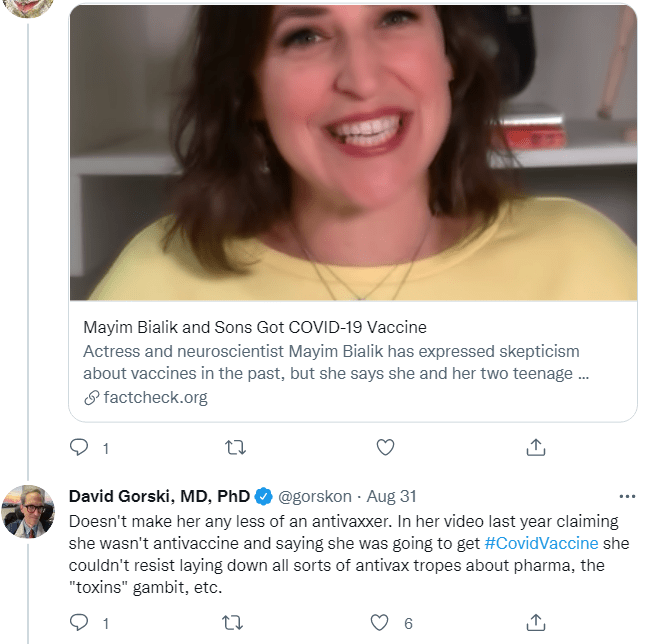
As to David Gorski he is a nasty piece of work although it does expose the paucity of his arguments,
LikeLiked by 1 person